
Bucephalandra pygmaea (Bucephalandra pygmaea)
Bucephalandra pygmaea is a very small perennial rheophyte with creeping, rooting stems, typically growing attached to stream rocks and capable of forming colonies.
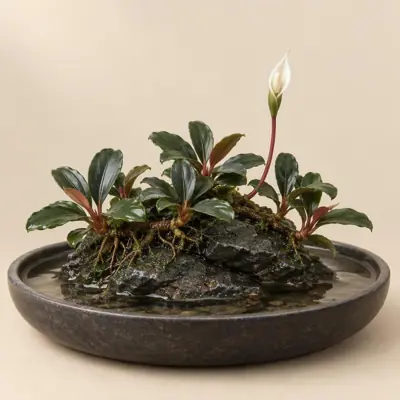
Overview
Bucephalandra pygmaea is a very small perennial rheophyte with creeping, rooting stems, typically growing attached to stream rocks and capable of forming colonies.
Origin and habitat
Bucephalandra pygmaea is native to Borneo, with sources differing in their accounts involving Sarikei and Kapit in Sarawak, Malaysia, and Kapuas Hilir and Kapuas Hulu in Indonesian Borneo. It grows along streams and waterfalls in wet to very wet lowland rainforest, mainly attached to shale and only rarely to sandstone, and is an obligate rheophyte dependent on flowing water and periodic flooding. Its climate environment is wet to very wet tropical lowland rainforest.
Characteristics
Mature plants are 1–3 cm tall and spread 0–50 cm. It is reported to grow slowly. The leaves are clustered, with reddish petioles; the thick, leathery blades are obovate to elliptic, semi-glossy dark green above and paler and usually reddish beneath, with a cuneate base and a rounded, shortly pointed tip. The inflorescence is solitary on a reddish peduncle; the broadly ovate spathe has a green, funnel-shaped, persistent lower part and a white upper part that later falls away, while the spadix has a female-flower zone, movable scale-like sterile stamens, a male-flower zone, and an appendix; the fruit is a flattened-globose berry containing many pale-brown, narrowly elliptic seeds, which remain in the persistent lower spathe after the pulp breaks down at maturity.
Watering
In its native habitat, Bucephalandra pygmaea occurs along streams and waterfalls and is an obligate rheophyte adapted to and dependent on flowing water and regular flooding.
Humidity and airflow
Bucephalandra pygmaea prefers high humidity.
Identification
Bucephalandra pygmaea is a very small obligate rheophyte with creeping, highly branched stems and small, thick, leathery leaves. Its staminal filaments are conspicuously dorsiventrally flattened and strap-shaped, with anthers borne on the ventral side and upward-pointing anther horns approximately as long as the anthers; scale-like sterile stamens occur between the female and male flower zones of the spadix.