
Butterfly-bush (Buddleja davidii)
Buddleja davidii is a woody shrub with branches that are often arching or spreading. It is a perennial, usually deciduous shrub, though it may be semi-evergreen in some environments; sources describe this differently.
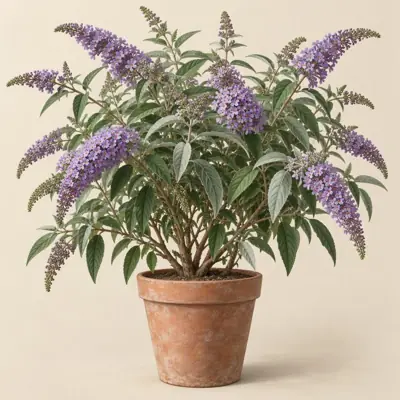
Overview
Buddleja davidii is a woody shrub with branches that are often arching or spreading. It is a perennial, usually deciduous shrub, though it may be semi-evergreen in some environments; sources describe this differently.
Origin and habitat
Buddleja davidii is native to Asia, with its range centered on central, southern, and western China and Tibet; sources differ on whether Japan is also part of its native range. Native habitats include hillside scrub and areas near mountain valleys; escaped plants are also common in wasteland, along roads and railways, in disturbed urban sites, and on walls. It is adapted to temperate and some subtropical environments and has been widely cultivated and naturalized in temperate regions in many parts of the world.
Characteristics
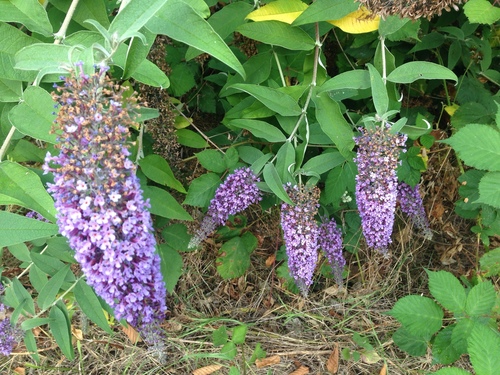
Sources differ, but mature height is reported at about 250–500 cm; with few sources, mature spread is reported at about 400–800 cm. It grows rapidly and has opposite, mainly lance-shaped to narrowly oblong-lance-shaped leaves with finely toothed margins, green to dark green upper surfaces, and gray-white to gray-green undersides from dense hairs. Small bisexual flowers are densely grouped in terminal flower clusters and have a fragrant or honey-like scent; wild forms are mainly pale purple to blue-purple or purple, while cultivated forms also include white, red, pink, and deep purple, with an orange-yellow area visible in the throat, and flowering occurs from summer into autumn. The fruit is reported to be a narrow, oblong capsule containing many very small seeds that can be dispersed by wind.
Light
Full sun is best, though partial sun is also acceptable.
Watering
It prefers moist, well-drained soil and should not remain poorly drained or persistently too wet; once established, it has some drought tolerance.
Temperature and dormancy
Sources differ, but a minimum temperature of about -15 °C is reported. A USDA hardiness-zone range is reported by a single source.
Growing medium and mounting
It prefers well-drained soil but adapts to various soil types, including loam, sand, and chalk, and can grow in acidic, neutral, or alkaline conditions; drainage should be improved in clay soil.
Propagation
It is reported to be propagated by cuttings, with new shoots used for cuttings in early summer or cuttings taken in a propagation greenhouse.
Common problems
Aphids may occur where ventilation is poor, stem-boring longhorn beetle larvae may occur from late spring into summer, and another reported problem is the two-spotted spider mite. Disease problems are generally reported to be uncommon. Its rapid growth and tendency to escape cultivation and naturalize mean it may become invasive in multiple regions and displace other vegetation. Severe cold may damage or kill back above-ground growth, and very cold regions may be difficult for the plant to survive, although it may resprout from the base after freezing in colder areas.
Identification
Distinctive features include long, dense, fragrant terminal flower clusters, opposite lance-shaped leaves, and gray-white hairy leaf undersides; the nectar attracts butterflies.
Photos


Sources
- Wikipedia (en): Buddleja davidii — CC BY-SA 4.0 · link
- 維基百科:大叶醉鱼草 — CC BY-SA 4.0 · link
- Wikipedia (ja): フサフジウツギ — CC BY-SA 4.0 · link
- Wikipedia (de): Schmetterlingsflieder — CC BY-SA 4.0 · link
- Wikipedia (fr): Buddleia de David — CC BY-SA 4.0 · link
- Wikipedia (es): Buddleja davidii — CC BY-SA 4.0 · link
- GBIF descriptions: Manual of the Alien Plants of Belgium; Checklist of introduced taxa in Cyprus; Database of Vascular — per dataset · link
- NC State Plant Toolbox: Buddleja davidii — copyright (facts only) · link
- Useful Tropical/Temperate Plants: Buddleja davidii — CC BY-NC-SA 3.0 (facts only) · link
- RHS Plants: Buddleja davidii — © RHS, facts only · link
- USDA PLANTS Database: Buddleja davidii — Public domain (US Government work) · link