
Bulbophyllum hybrid (Bulbophyllum hybrid)
Bulbophyllum is reported to consist mainly of sympodial orchids that grow as epiphytes or on rocks.
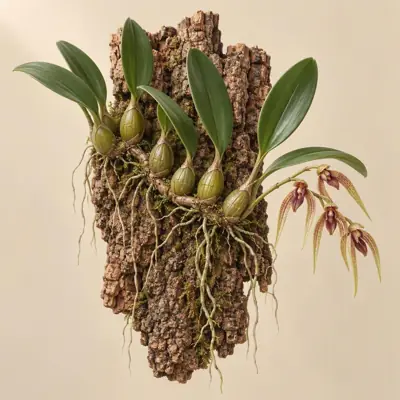
Overview
Bulbophyllum is reported to consist mainly of sympodial orchids that grow as epiphytes or on rocks.
Origin and habitat
Bulbophyllum is reported to have a pantropical distribution that includes Africa, Madagascar, India, Southeast Asia, Australia, Latin America, the West Indies, and islands in the Indian and Pacific oceans, with montane forests of Papua New Guinea forming a major center of diversity. Species are reported to grow mainly as epiphytes on trees or on rocks across varied warm-region habitats; many cultivated species originate in warm, wet, highly humid tropical forests, and the montane forests of Papua New Guinea have particularly high species diversity. The genus is reported to occur primarily in warm, wet, highly humid tropical environments.
Characteristics
Pseudobulbs are reported to bear leaves at their tips, with the leaves usually fleshy or leathery and often solitary. Inflorescences are reported to arise from the pseudobulb, usually at its base, as unbranched racemes bearing from a single flower to many; the dorsal and lateral sepals are separate, the lateral sepals may be separate or fused, the petals are separate and smaller than the lateral sepals, and the lip is often fleshy, curved, and movably attached at the base of the column. Flower form is reported to vary greatly, with some species having a carrion-like odor and others a mild or fruity fragrance. Most species are reported to grow continuously and flower throughout the year under suitable cultivation, without a distinct dormancy, and the fruit is reported to be a capsule without a beak.
Light
Bulbophyllum is reported to suit medium light and not deep shade.
Watering
In cultivation, Bulbophyllum is reported to need consistently moist conditions because its fine root system requires long-term moisture, although brief drying can be tolerated. Specialist guidance generally describes the drying preference as keep slightly dry.
Humidity and airflow
Specialist guidance generally indicates that Bulbophyllum needs good airflow.
Temperature and dormancy
Specialist guidance generally describes Bulbophyllum as warm-growing.
Growing medium and mounting
Some smaller species are reported to grow in pots with fine-grade bark, while many species have pseudobulbs spaced widely along cord-like rhizomes and are generally better suited to mounting on boards. Bulbophyllum is reported to be epiphytic and to have fine terrestrial roots. Specialist guidance generally indicates a preference for sphagnum moss.
Feeding
Bulbophyllum is reported to have moderate fertilizer requirements in cultivation.
Common problems
The fine roots are reported to be readily damaged by disturbance, while inadequate airflow and deep shade may adversely affect cultivation; sufficient airflow is needed even in enclosed growing cases. Most species are reported to be unable to tolerate low temperatures or frost.
Identification
Bulbophyllum is reported to have stems clearly differentiated into rhizomes and pseudobulbs, with leaves at the pseudobulb tips and inflorescences usually arising laterally from the pseudobulb base. Its roots are reported to be fine and linear or fibrous, spreading along tree or rock surfaces or hanging from branches, while a movable lip is a notable floral feature.