
camellia (Camellia japonica)
Sources differ in describing Camellia japonica as an evergreen woody shrub or small tree. It is a perennial, long-lived evergreen woody plant.
Overview
Sources differ in describing Camellia japonica as an evergreen woody shrub or small tree. It is a perennial, long-lived evergreen woody plant.
Origin and habitat
Sources differ on details of its native range in East Asia, which includes China, Japan, Korea, and Taiwan. It naturally grows in forests, mountains, and areas near the coast. It is adapted to warm-temperate to subtropical environments and prefers cool, partly shaded conditions with moisture and good drainage.
Characteristics
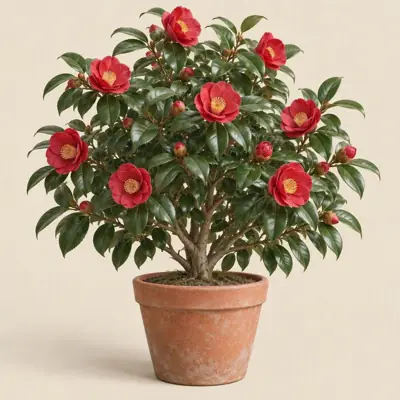
Sources differ on mature height, placing it at about 150–1100 cm, while a single source reports a mature spread of about 400–800 cm. It grows slowly and has alternate, thick, leathery leaves that range from elliptic to ovate or oblong, with dark green, often glossy upper surfaces, paler undersides, finely serrated margins, and short-pointed to tapering tips. The large flowers are usually solitary or paired in the leaf axils or near branch tips, are mainly red, pink, or white, have numerous stamens whose filaments may be joined at the base, and cultivated forms can show varied forms including more petals, double flowers, and markings. Sources differ somewhat on flowering season, but flowering is mainly from late winter through spring, and cultivated forms may flower for a longer period; the fruit is a nearly spherical capsule with brown, relatively large, nearly hemispherical to spherical, oil-rich seeds.
Light
Camellia japonica prefers partial shade to shade and should avoid intense sun and dry winter winds, although some sources indicate that brighter or full-sun positions can be suitable under appropriate conditions.
Watering
Water regularly to maintain moderate moisture while keeping the growing medium well drained; steady watering during flower-bud development can reduce bud drop.
Humidity and airflow
Camellia japonica prefers high humidity and is generally reported to need moderate airflow.
Temperature and dormancy
Sources differ on minimum temperature, with limited evidence placing it at about -1.1 °C. Sources differ on its hardiness-zone range and on which parts of that range provide more reliable growing conditions. Camellia japonica is frost hardy.
Growing medium and mounting
Camellia japonica suits organic-rich, well-drained loam or other well-drained growing media and prefers acidic to neutral conditions.
Feeding
A single source reports that phosphorus and potassium fertilizer can be supplied during summer flower-bud development, that organic fertilizer or compost can be applied seasonally, and that bone meal and wood ash are also options for supplying phosphorus and potassium.
Propagation
Camellia japonica can be propagated from seed, cuttings, or grafting; cultivation information from Taiwan describes cuttings as more common and using year-old shoots after flowering from summer into autumn, while RHS also recommends semi-hardwood cuttings.
Common problems
Potential pests include aphids, scale insects, weevils, and mites, with additional camellia scale-related pests also reported. A single source reports susceptibility to Phytophthora root rot, camellia gall, leaf blight, yellow mottle virus, and petal blight, while Armillaria disease is less common. Inconsistent watering can cause bud drop, while intense sun can cause leaf scorch or yellowing. Flower buds and open flowers are sensitive to low temperatures, and cold dry winds and intense morning sun should also be avoided.
Identification
Camellia japonica is distinguished by evergreen, leathery, glossy dark green leaves and large, conspicuous flowers appearing from winter into spring; cultivated forms have highly varied flower colors and include both single and double forms.
Photos


Sources
- Wikipedia (en): Camellia japonica — CC BY-SA 4.0 · link
- 維基百科:山茶花 — CC BY-SA 4.0 · link
- Wikipedia (ja): ツバキ — CC BY-SA 4.0 · link
- Wikipedia (de): Japanische Kamelie — CC BY-SA 4.0 · link
- Wikipedia (es): Camellia japonica — CC BY-SA 4.0 · link
- NC State Plant Toolbox: Camellia japonica — copyright (facts only) · link
- Wikipedia (pt): Camellia japonica — CC BY-SA 4.0 · link
- TaiCOL 臺灣物種名錄: Camellia japonica — CC BY 4.0 · link
- 農業知識入口網 植物圖鑑: Camellia japonica — © MOA, facts only · link
- Useful Tropical/Temperate Plants: Camellia japonica — CC BY-NC-SA 3.0 (facts only) · link
- RHS Plants: Camellia japonica — © RHS, facts only · link
- USDA PLANTS Database: Camellia japonica — Public domain (US Government work) · link
- Top Tropicals catalog: Camellia japonica — © Top Tropicals LLC (facts only) · link