
Sasanqua camellia (Camellia sasanqua)
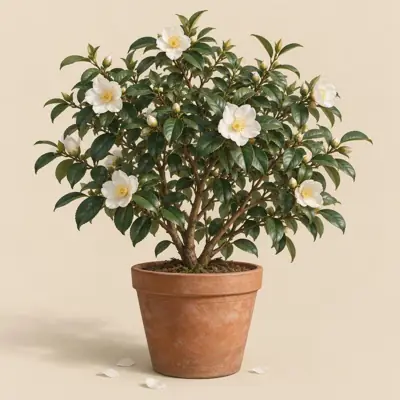
Camellia sasanqua is an evergreen broadleaf shrub to small tree. It is reported to be perennial.
Overview
Camellia sasanqua is an evergreen broadleaf shrub to small tree. It is reported to be perennial.
Origin and habitat
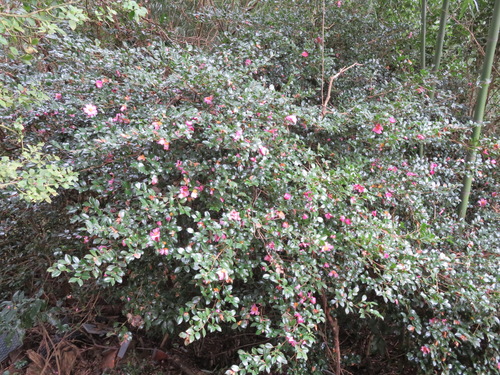
Sources differ on its native range, but describe it as primarily native to southern Japan, including Shikoku, Kyushu, and the Ryukyu or Nansei Islands. It occurs in mountain scrub, grassy slopes, forest openings, and evergreen forest environments in southern Japan. It is adapted to warm-temperate to subtropical environments with warmer summers, and its native distribution is concentrated in the warmer southern parts of Japan.
Characteristics
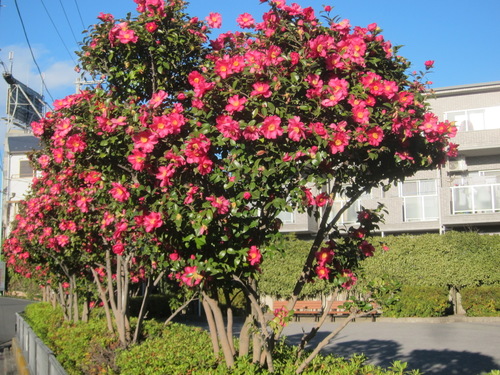
Sources differ on mature height, placing it at about 200–1000 cm; a single source reports a mature spread of about 152.4–213.4 cm. It is reported to grow quickly, with alternate, evergreen, leathery to somewhat thick, elliptic to ovate leaves that have finely serrated margins and glossy dark-green surfaces; young shoots, petioles, and main veins may bear short soft hairs. Flowers are usually solitary at shoot tips or in leaf axils; wild forms are mainly white and may be pale pink, while cultivated forms may be white, pink, red, or multicolored, with single, semi-double, or double flowers, some of which are fragrant; sources differ on flowering time, describing it broadly as autumn to winter with variation among cultivar groups. The fruit is reported to be a capsule, ranging from nearly spherical or irregularly spherical to pear-shaped, with a surface bearing short hairs or soft hairs; sources also describe seeds within its chambers and dark brown seeds exposed when the fruit splits.
Light
Camellia sasanqua grows in full sun to partial sun and can adapt to a broad range of light conditions; in hot regions it can be kept out of strong afternoon sun.
Watering
Maintain adequate soil moisture while avoiding poor drainage; established plants have some drought tolerance, but soil moisture is especially important under full sun and high summer temperatures.
Temperature and dormancy
Sources differ and are few regarding the lower temperature limit, placing it at about -12.5 °C, while a single source reports an upper limit of about 40 °C.
Growing medium and mounting
It prefers loose, fertile, well-drained soil and can grow in clay, loam, or sandy soil, with slightly acidic to neutral conditions being suitable.
Propagation
It is reported to be propagated by cuttings or grafting; a Chinese-language source indicates that semi-mature stem cuttings are the main method and that Camellia oleifera can also be used as grafting rootstock.
Common problems
Potential pests include aphids, camellia scales, peony scale, purple mites, and Euproctis pseudoconspersa. Phytophthora root rot is reported as a possible disease, although the source describes Camellia sasanqua as having better resistance to it than some camellias. Poor drainage is unfavorable to growth, and white-tailed deer feeding, some mites, and scale insects are also horticultural problems. The species is not particularly tolerant of severe cold, strong cold weather during flowering can cause flowers to drop, and shelter from cold winter winds is preferable; some cultivated forms are more cold-tolerant than the species.
Identification
Compared with Camellia japonica, Camellia sasanqua is reported to generally have smaller flowers that open earlier in late autumn, petals that can fall individually, a hairy ovary, and usually smaller leaves.
Photos


Sources
- Wikipedia (en): Camellia sasanqua — CC BY-SA 4.0 · link
- 維基百科:茶梅 — CC BY-SA 4.0 · link
- Wikipedia (ja): サザンカ — CC BY-SA 4.0 · link
- Wikipedia (fr): Camellia sasanqua — CC BY-SA 4.0 · link
- Wikipedia (es): Camellia sasanqua — CC BY-SA 4.0 · link
- NC State Plant Toolbox: Camellia sasanqua — copyright (facts only) · link
- Useful Tropical/Temperate Plants: Camellia sasanqua — CC BY-NC-SA 3.0 (facts only) · link
- USDA PLANTS Database: Camellia sasanqua — Public domain (US Government work) · link