
papaya (Carica papaya)
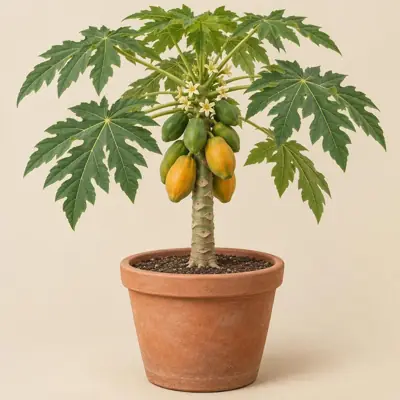
Sources describe Carica papaya somewhat differently, but it is characterized as a large, evergreen, upright, usually single-stemmed and sparsely branched tree-like herb, with a stem that is only slightly woody or not woody and an appearance resembling a small tree. It is a perennial, evergreen, and relatively short-lived plant.
Overview
Sources describe Carica papaya somewhat differently, but it is characterized as a large, evergreen, upright, usually single-stemmed and sparsely branched tree-like herb, with a stem that is only slightly woody or not woody and an appearance resembling a small tree. It is a perennial, evergreen, and relatively short-lived plant.
Origin and habitat
Sources differ on its native range, which is described as tropical America, particularly from southern Mexico through Central America. Its original wild habitat is not fully certain; it is now widely cultivated in tropical and subtropical regions and can grow at higher elevations near the equator. It is suited to warm tropical to subtropical climates, does not tolerate low temperatures, and prefers environments with evenly distributed rainfall.
Characteristics
Sources differ on mature height, placing it at about 190–1000 cm, while the few sources for mature spread report about 250–400 cm. It grows rapidly and has large, long-stalked, deeply palmately lobed leaves concentrated near the top of the upright stem, with conspicuous leaf scars left on the lower stem after leaves fall. Flowers occur in the leaf axils or near the stem and may be male, female, or bisexual; plants are usually described as predominantly having male and female flowers on separate plants, with flower colors ranging from creamy white or white to yellow-green, and some sources describe them as fragrant. In suitable conditions flowering can continue throughout the year, and the large berry fruits may be oblong, ovoid, or pear-shaped, with skin becoming yellow, amber, or orange at maturity, soft orange-yellow or red flesh, and many seeds that become black when mature in a central cavity.
Light
Carica papaya prefers full sun; when grown indoors it requires bright light and a protected position.
Watering
Maintain moderate moisture with good drainage and avoid waterlogging; some horticultural sources recommend watering after the surface soil has dried.
Temperature and dormancy
Few sources provide a lower temperature figure and sources differ, with about 12 °C reported. Sources differ on the ideal temperature, placing it at about 25–30 °C. Few sources provide a maximum temperature figure and sources differ, with about 44 °C reported. A USDA hardiness-zone rating is reported, and Carica papaya is generally reported to tolerate brief light frost.
Growing medium and mounting
Carica papaya prefers deep, humus-rich soil with good drainage and aeration; it can grow in loamy or sandy soil across acidic, neutral, and alkaline conditions.
Feeding
Carica papaya is reported to have high fertility requirements.
Propagation
Carica papaya is propagated by seed; the seeds germinate readily but require sufficient warmth, and under suitable conditions plants can begin producing fruit relatively soon.
Common problems
Potential pests include spider mites, thrips, greenhouse whiteflies, and nematodes. Root rot and papaya ringspot disease may occur, and papaya ringspot disease can be spread by aphids. Waterlogging can quickly cause plant death, while low temperatures stop growth and reduce fruit size and quality. It does not tolerate cold, and its relatively soft stem can make it prone to falling in strong winds or typhoons; sufficiently low temperatures may be fatal.
Identification
Carica papaya has a crown of large palmate leaves at the top of an upright single stem, conspicuous leaf scars on the lower stem, latex throughout the plant, and fruits clustered near the stem below the leaf crown.
Photos


Sources
- Wikipedia (en): Papaya — CC BY-SA 4.0 · link
- 維基百科:番木瓜 — CC BY-SA 4.0 · link
- Wikipedia (ja): パパイア — CC BY-SA 4.0 · link
- Wikipedia (de): Papaya — CC BY-SA 4.0 · link
- Wikipedia (fr): Papayer — CC BY-SA 4.0 · link
- Wikipedia (es): Carica papaya — CC BY-SA 4.0 · link
- GBIF descriptions: The checklist of alien seed plants of D.R. Congo, based on evidence from herbarium collections; Capt — per dataset · link
- Wikipedia (it): Carica papaya — CC BY-SA 4.0 · link
- Wikipedia (pt): Carica papaya — CC BY-SA 4.0 · link
- Useful Tropical/Temperate Plants: Carica papaya — CC BY-NC-SA 3.0 (facts only) · link
- RHS Plants: Carica papaya — © RHS, facts only · link
- USDA PLANTS Database: Carica papaya — Public domain (US Government work) · link
- Top Tropicals catalog: Carica papaya — © Top Tropicals LLC (facts only) · link