
jaggery palm (Caryota urens)
Caryota urens is an evergreen, single-trunked, unbranched palm. It is a perennial that flowers and fruits once after years of vegetative growth, then dies after its final fruits mature.
Overview
Caryota urens is an evergreen, single-trunked, unbranched palm. It is a perennial that flowers and fruits once after years of vegetative growth, then dies after its final fruits mature.
Origin and habitat
Sources differ on its native range, with India and Sri Lanka reported. It occurs mainly in moist lowland and lower montane forests, and is also found in rainforest openings and fields; another source records it in limestone areas and valley forests of southern China. It is adapted to humid tropical climates but can also grow in warm temperate and drier areas.
Characteristics
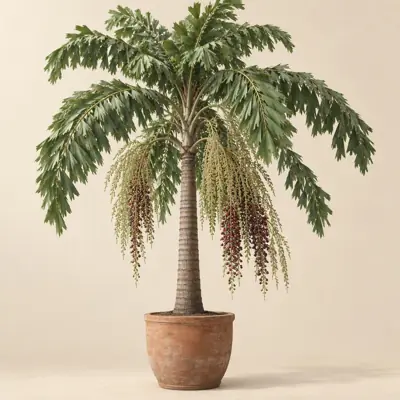
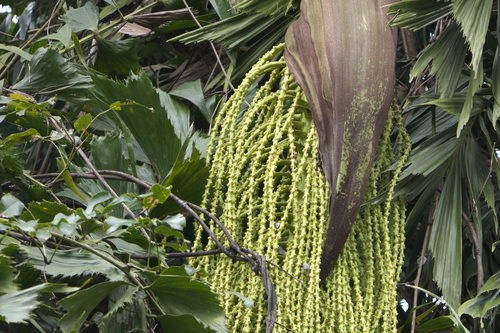
Sources differ on mature height, placing it at about 1200–2000 cm. A limited source base reports a mature spread of about 600 cm and generally describes growth as slow. The large, twice-pinnate leaves are triangular to arching or drooping and green to dark green, with mostly wedge-shaped or inversely triangular leaflets whose irregularly toothed or divided tips create a fishtail-like appearance. Sources differ in their descriptions of the large, drooping, much-branched inflorescences and flowers; the flowers are unisexual on the same plant, and the inflorescences develop progressively downward from the upper part of the plant.
Light
It is reported to grow in full sun, including when smaller, while the same limited evidence also describes a preference for moist, more shaded sites.
Watering
It is reported to prefer moist conditions, while showing some adaptation to dry climates and growing well in humid tropical environments.
Temperature and dormancy
With few sources available, the reported minimum temperature is about 5 °C.
Growing medium and mounting
It is reported to prefer moist conditions and to tolerate a range of soil acidity and alkalinity.
Common problems
After completing its flowering and fruiting cycle progressively from the top downward, the plant naturally dies. It is generally described as sensitive to low temperatures, with mature plants potentially dying under sufficiently cold conditions.
Identification
Caryota urens has a single trunk without basal side shoots, large twice-pinnate leaves with wedge-shaped leaflets and fishtail-like divided margins, and mature plants produce very long drooping inflorescences that appear sequentially from top to bottom.
Photos


Sources
- Wikipedia (en): Caryota urens — CC BY-SA 4.0 · link
- Wikipedia (ja): クジャクヤシ — CC BY-SA 4.0 · link
- Wikipedia (fr): Caryota urens — CC BY-SA 4.0 · link
- Wikipedia (es): Caryota urens — CC BY-SA 4.0 · link
- Useful Tropical/Temperate Plants: Caryota urens — CC BY-NC-SA 3.0 (facts only) · link
- USDA PLANTS Database: Caryota urens — Public domain (US Government work) · link