
beach sheoak (Casuarina equisetifolia)
Casuarina equisetifolia is a perennial evergreen tree with a finely branched crown and drooping, slender, jointed green to gray-green branchlets that resemble horsetails; although it looks like a conifer, it is an angiosperm.
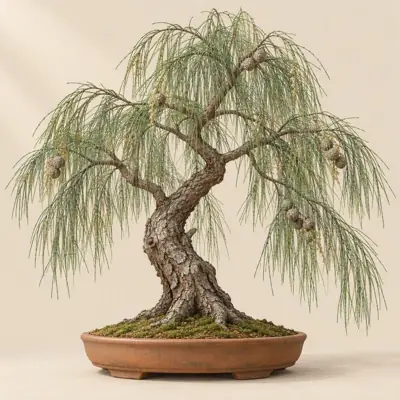
Overview
Casuarina equisetifolia is a perennial evergreen tree with a finely branched crown and drooping, slender, jointed green to gray-green branchlets that resemble horsetails; although it looks like a conifer, it is an angiosperm.
Origin and habitat
Sources differ in their descriptions of its native-range boundaries, which encompass northern and eastern Australia, Southeast Asia to India and New Guinea, the western Pacific, and some Pacific islands. It occurs naturally mainly in tropical to subtropical coastal environments, including beaches, dunes, sandy areas near estuaries, areas behind foredunes, and gentle coastal slopes, and it can grow in poor sandy environments. It is reported to be adapted to semiarid through wetter tropical and subtropical environments, with cultivation information indicating preferences and tolerances spanning broad ranges of temperature, rainfall, and elevation.
Characteristics
Sources differ on mature height, giving a range of about 600–3500 cm. It grows rapidly. The true leaves are highly reduced to tiny scale-like teeth arranged in whorls, while the conspicuous needle-like structures are reported to be slender, jointed, often drooping green branchlets. Sources differ in their descriptions of the small, inconspicuous, unisexual flowers and their catkin-like inflorescences; most describe male and female flowers on the same plant, and flowering is reported in early summer. Mature fruiting structures are reported to be woody, ovoid to nearly spherical and reminiscent of small cones, containing small winged fruits or seeds.
Watering
It can adapt from semiarid to wetter environments, although USDA information rates its drought tolerance as low, and in the wild it commonly occurs on well-drained coastal sands.
Growing medium and mounting
It can grow in poor coastal sandy soils; USDA information lists it as adapted to coarse- and medium-textured soils but not fine-textured soils, with low tolerance of oxygen-deficient soil conditions.
Propagation
It is reported to be propagated by seed.
Common problems
Sources differ in describing its potential to escape cultivation, naturalize, or create invasive pressure; Taiwan's species list records it as non-native and naturalized in Taiwan, while another source reports that an introduced population on Lanyu threatens native plant habitat. It tolerates salt and coastal wind conditions and is often used for wind protection and coastal protection, but has low tolerance of oxygen-deficient soil conditions.
Identification
It is reported to be identifiable by the combination of slender, jointed green branchlets resembling horsetails or needles, true leaves reduced to whorled scales, and small woody cone-like fruiting structures.
Photos


Sources
- Wikipedia (en): Casuarina equisetifolia — CC BY-SA 4.0 · link
- 維基百科:木麻黄 — CC BY-SA 4.0 · link
- Wikipedia (ja): トクサバモクマオウ — CC BY-SA 4.0 · link
- Wikipedia (de): Schachtelhalmblättrige Kasuarine — CC BY-SA 4.0 · link
- Wikipedia (fr): Filao — CC BY-SA 4.0 · link
- Wikipedia (es): Casuarina equisetifolia — CC BY-SA 4.0 · link
- TaiCOL 臺灣物種名錄: Casuarina equisetifolia — CC BY 4.0 · link
- Useful Tropical/Temperate Plants: Casuarina equisetifolia — CC BY-NC-SA 3.0 (facts only) · link
- USDA PLANTS Database: Casuarina equisetifolia — Public domain (US Government work) · link