
Albany pitcher plant (Cephalotus follicularis)
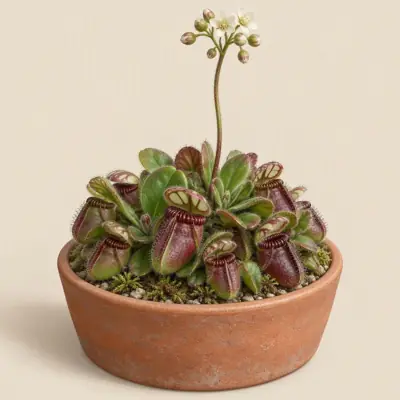
Cephalotus follicularis is a small, low-growing, clumping terrestrial carnivorous herb that forms ground-hugging rosettes and can produce additional rosettes from underground rhizomes and runners. It is perennial; sources differ in describing it as evergreen, winter-green, or semi-evergreen.
Overview
Cephalotus follicularis is a small, low-growing, clumping terrestrial carnivorous herb that forms ground-hugging rosettes and can produce additional rosettes from underground rhizomes and runners. It is perennial; sources differ in describing it as evergreen, winter-green, or semi-evergreen.
Origin and habitat
It is native to a restricted range in southwestern Australia, described more specifically by a French-language source as the area from Albany to Augusta. It is reported to grow naturally in moist habitats, including peat bogs in southwestern Australia, with coastal sandy slopes and peat wetlands also recorded. Its natural environment is reported to have a relatively mild Mediterranean-type climate influenced by proximity to the ocean.
Characteristics
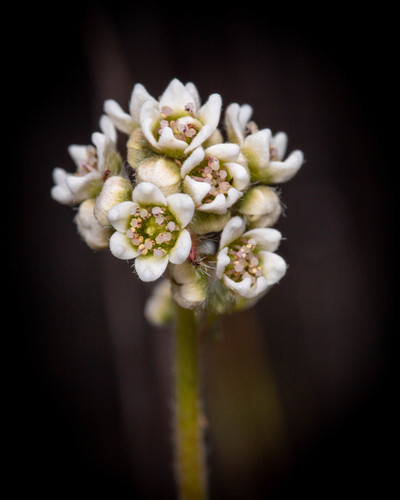
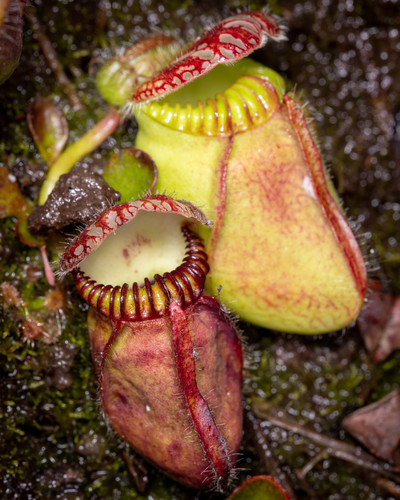
Sources differ on mature height, placing it at about 10–20 cm, while the few available sources indicate a mature spread of about 10–50 cm. The foliage is dimorphic, comprising ordinary flat, thick, leathery leaves that range from spoon-shaped to obovate and highly specialized, upward-opening, fluid-filled pitcher traps with inward-pointing tooth-like structures around the opening; sources differ on details, and the pitchers may become dark red in strong light while remaining greener in shade. The small flowers range from white or creamy white to pale green and are borne on slender flower stalks; English-language sources describe the flowers as bisexual, regular, and with floral parts in a repeated pattern, while a French-language source describes them as lacking petals. Flowering is reported to occur in summer.
Light
It grows in full sun to partial sun; stronger light can produce red, maroon, or dark pitchers, while plants in shadier conditions generally remain green.
Watering
Keep evenly moist in a moist but well-drained medium; a Japanese-language cultivation source also recommends watering thoroughly enough to wet the medium and allow water to drain from the bottom.
Temperature and dormancy
The few available sources place the preferred temperature range at about 5–32 °C, with about 5 °C at the low end and about 32 °C at the high end. It is reported to have cold winter dormancy.
Growing medium and mounting
A low-nutrient, acidic medium is suitable; sources include loamy or sandy media ranging from acidic to neutral and kept moist but well drained, as well as sphagnum moss, Kanuma soil, or peat. Peat with perlite is also reported as a substrate type.
Feeding
Use a low-nutrient medium; a Japanese-language source advises against nutrient-rich soil and states that deliberately feeding insects is unnecessary. The pitchers are reported to attract prey with nectar so that it falls into digestive fluid, with ants making up most of the captured prey.
Propagation
Cephalotus follicularis can be propagated from seed, root cuttings, leaf cuttings, or division, and it also produces new rosettes from underground rhizomes or runners to form clumps.
Common problems
Scale insects are reported as a possible pest, while obvious disease problems are generally reported to be absent. Light conditions strongly affect pitcher coloration, with shadier conditions producing greener pitchers; a Japanese-language source also reports that overly nutrient-rich medium may reduce or eliminate carnivorous leaves. Seasonal cooling and reduced daylight trigger winter dormancy, and cultivation sources recommend maintaining a suitable temperature range.
Identification
Cephalotus follicularis is distinguished by specialized leaves forming passive, fluid-filled pitfall pitchers with inward-pointing tooth-like structures around the opening; the lid reduces rain entry, while translucent areas can interfere with trapped insects as they seek an exit.
Photos


Sources
- Wikipedia (en): Cephalotus — CC BY-SA 4.0 · link
- 維基百科:土瓶草 — CC BY-SA 4.0 · link
- Wikipedia (en): Australian pitcher plant — CC BY-SA 4.0 · link
- Wikipedia (ja): フクロユキノシタ — CC BY-SA 4.0 · link
- Wikipedia (de): Zwergkrug — CC BY-SA 4.0 · link
- Wikipedia (fr): Cephalotus follicularis — CC BY-SA 4.0 · link
- RHS Plants: Cephalotus follicularis — © RHS, facts only · link