
Cereus forbesii (Cereus forbesii)
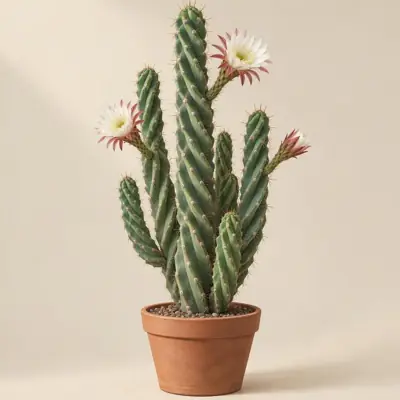
Cereus forbesii is a columnar cactus with upright stems that may branch and form clumps; 'Spiralis' has distinctly spirally twisted stems.
Overview
Cereus forbesii is a columnar cactus with upright stems that may branch and form clumps; 'Spiralis' has distinctly spirally twisted stems.
Origin and habitat
Sources differ on the native range, describing it as extending from Bolivia to north-central Argentina. It inhabits dry, windy hills, dry plains, sparse forests or woodlands, and the edges of salt flats. It is reported to be adapted to arid conditions, strong sunlight, and substantial day-night and seasonal temperature differences; in its native habitat, winter nights may approach freezing, and higher elevations may even receive snow.
Characteristics
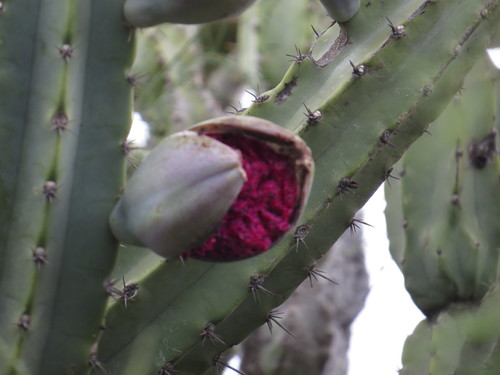
Sources differ, but mature plants are reported at about 250–400 cm tall; a single source reports a spread of about 50–100 cm. The large, funnel-shaped flowers are white to reddish or pinkish white; some descriptions give them reddish outer parts and white to pinkish-white inner parts, and the flowers may open at night. Flowering time varies with growing conditions, and sources differ in the seasons they report; mature fruits are red and fleshy, while sources also differ in describing a bluish bloom on the surface and abundant pale-purple flesh containing small black seeds. It is reported to grow quickly.
Light
Young plants do well in bright partial sun or light shade, while more mature plants take full sun; greenhouse-grown plants need ample light.
Watering
Water regularly during the growing season, allowing the growing medium to dry completely between waterings; keep it dry to nearly dry in winter.
Humidity and airflow
It is reported to need good airflow.
Temperature and dormancy
A single source gives a minimum of about 0 °C, while a specialist source gives a cold minimum of about -2 °C; sources are few. It is generally described as frost tender and should be kept above freezing, although it tolerates brief light frost. A single source reports a USDA hardiness zone, and a specialist source reports that it rests cool and dry in winter.
Growing medium and mounting
Use a well-drained cactus growing medium; sandy soil may be used, with acidic, neutral, or alkaline soil conditions. It needs a fast-draining mix.
Propagation
Propagation is by cuttings or seed; allow a cutting surface to dry and form callus before planting.
Common problems
It is reported to be susceptible to mealybugs and scale insects and generally to have few diseases. Freezing temperatures are reported to cause severe damage; use a well-drained medium and avoid watering again before the medium has dried. It does not tolerate prolonged freezing, so growing conditions should avoid frost and severe cold; mature plants take full sun, while native populations are adapted to substantial day-night temperature differences.
Identification
The most distinctive feature of the cultivar 'Spiralis' is the longitudinal spiral growth of its columnar stems; Cereus forbesii itself has ribbed, spiny cylindrical stems that are bluish green when young and later become paler green to gray-green.
Photos


Sources
- Wikipedia (en): Cereus forbesii — CC BY-SA 4.0 · link
- Wikipedia (es): Cereus forbesii — CC BY-SA 4.0 · link
- LLIFLE Encyclopedia of living forms: Cereus forbesii — CC BY-SA · link
- RHS Plants: Cereus forbesii — © RHS, facts only · link
- Desert-Tropicals: Cereus forbesii — © Philippe Faucon (desert-tropicals.com), facts only · link
- Cereus forbesii cv. Spiralis | Giromagi cactus and succulents for sale | Buy pla (www.giromagi.com) — facts only (§12) · link
- PUKUBOOK: Cereus forbesii — CC BY-NC (facts only) · link