
hedge cactus (Cereus hildmannianus)
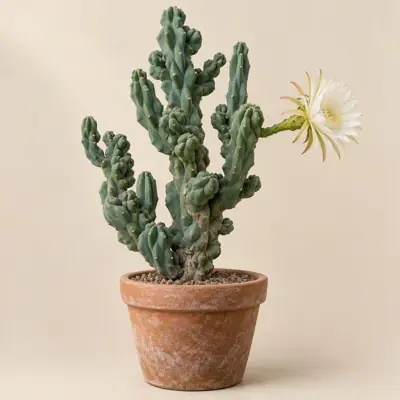
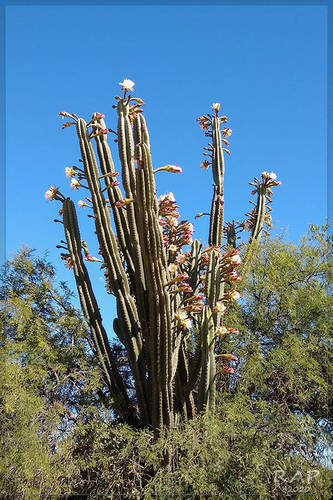
Cereus hildmannianus is reported to be a perennial evergreen succulent cactus with a columnar, shrub- to tree-like habit, a distinct main trunk, abundant branching, and an overall candelabra-like form.
Overview
Cereus hildmannianus is reported to be a perennial evergreen succulent cactus with a columnar, shrub- to tree-like habit, a distinct main trunk, abundant branching, and an overall candelabra-like form.
Origin and habitat
Sources differ on its native range, which is described as South American and mainly including Brazil, Paraguay, Uruguay, Bolivia, and Argentina, with some uncertainty about the native distribution. It is reported from forests, savannas, and grasslands, as well as sandy or rocky soils, rocky outcrops, and cliffs; in some areas it occurs on plateaus and may occasionally grow epiphytically on trees or shrubs. It is reported to be adapted to warm-temperate through tropical environments, occurring in seasonally dry areas as well as more humid or semi-humid forests, across elevations from sea level into higher ground.
Characteristics
Sources differ, but with few independent sources, mature height is reported at about 500–1500 cm. Sources differ on growth rate, describing it either as having measurable annual growth or as slow. Sources differ in their descriptions of the large, white, funnel-shaped to narrowly funnel-shaped flowers, which open at night and close in the morning. It is reported to flower at night from spring through summer; the fruit is generally globose to pear-shaped and juicy, becoming red to yellow when ripe, with white pulp and black seeds.
Light
Mature plants are reported to prefer full sun, while young plants need shade; the species takes full sun.
Watering
It is reported to need ample watering during active growth and greatly reduced watering during dormancy; mature plants are drought tolerant, and the growing medium should drain well.
Temperature and dormancy
Sources differ, and with few independent sources the reported minimum is about -10 °C; another single source also reports about -10 °C as a cold minimum. Cereus hildmannianus is frost hardy and tolerates brief light frost. It is generally reported to rest cool and dry in winter.
Growing medium and mounting
It is reported to need well-drained soil and can grow in sandy, rocky, or shallow rocky soils in the wild; another source reports a preference for acidic conditions. It is reported to occur epiphytically and needs a fast-draining mix.
Propagation
It is reported to be propagated by seed or cuttings.
Common problems
Poor drainage or excessive watering during dormancy is reported to conflict with its preference for drier management; in some regions, escaped plants have also been recorded as invasive. When the soil is dry, it is reported to tolerate brief temperatures below freezing.
Identification
Sources differ in their descriptions of the columnar, segmented stems, which are often blue-green or glaucous when young and become darker green with age; they typically have several ribs and few or no spines, although some subspecies are more spiny.
Photos


Sources
- Wikipedia (en): Cereus hildmannianus — CC BY-SA 4.0 · link
- Wikipedia (de): Cereus hildmannianus — CC BY-SA 4.0 · link
- Wikipedia (fr): Cierge du Pérou — CC BY-SA 4.0 · link
- Wikipedia (es): Cereus hildmannianus — CC BY-SA 4.0 · link
- LLIFLE Encyclopedia of living forms: Cereus hildmannianus — CC BY-SA · link
- Useful Tropical/Temperate Plants: Cereus hildmannianus — CC BY-NC-SA 3.0 (facts only) · link
- PUKUBOOK: Cereus hildmannianus — CC BY-NC (facts only) · link