
Maule's quince (Chaenomeles japonica)
Chaenomeles japonica is a perennial deciduous woody plant that forms a thorny, spreading to broadly spreading, often multi-stemmed shrub and can expand by root suckers into clumps.
Overview
Chaenomeles japonica is a perennial deciduous woody plant that forms a thorny, spreading to broadly spreading, often multi-stemmed shrub and can expand by root suckers into clumps.
Origin and habitat
Sources differ on descriptions of its native range in Japan, with central to southern Japan given as the principal native range. It occurs in low-mountain woodland and in sunny environments such as mountain slopes, grassland, and riverbanks. It is reported from temperate Asian environments.
Characteristics
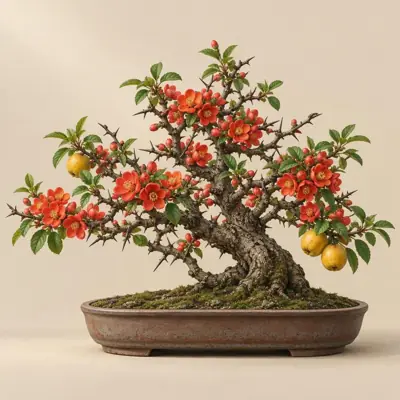
Sources differ on mature height, placing it at about 30–100 cm, while limited sourcing reports a mature spread of about 150–250 cm. Sources differ on growth rate and on some leaf descriptions; the green leaves range from roughly lance-shaped to obovate, with another description calling them elliptic, and they have serrated margins and may be hairless or glossy, while the large stipules are kidney-shaped and serrated. Flowers are usually clustered and commonly orange, orange-red to brick-red, with pink, white, or multicolored forms also occurring; flowering is mainly from late winter through spring, often before or while the leaves emerge, with some sources recording a smaller repeat bloom in summer. The ripe fruit is yellow to golden yellow, fragrant, and may be spherical, apple-shaped, or nearly barrel-shaped.
Light
It grows in full sun to partial sun, with full sun more suitable for better flowering.
Watering
Well-drained conditions are preferred, and the soil may be kept moist but well drained; watering is normal in summer and substantially reduced in winter.
Growing medium and mounting
It tolerates a broad range of soils, including chalk, clay, loam, and sand, and prefers good drainage; it can grow in acidic, neutral, or alkaline soil, although calcareous or high-pH soil may slow growth and cause yellowing.
Feeding
Some sources recommend organic fertilizer in autumn and winter and chemical fertilizer in spring, while USDA information describes its fertility requirement as low.
Propagation
It can be propagated by seed, cuttings, and division, with root cuttings also recorded by a source. Sources differ on the cold-stratification requirements for seed propagation.
Common problems
New shoots are reported to be susceptible to aphids, with scale insects and mites occasionally reported as problems. In rainy years, fungal leaf spot is reported to occur and may cause leaf drop when severe. High-pH or calcareous soil may cause slow growth or yellowing; root suckers can spread the plant outward, and thorny branches can readily catch debris. USDA information describes drought tolerance as high, while rainy years may increase the risk of fungal leaf spot and leaf drop.
Identification
Chaenomeles japonica is low and broadly spreading with thorny branches; conspicuous orange-red to red flowers often appear before the leaves unfold, followed by fragrant yellow fruit, and large kidney-shaped stipules are another identifying feature.
Photos


Sources
- Wikipedia (en): Chaenomeles japonica — CC BY-SA 4.0 · link
- 維基百科:日本海棠 — CC BY-SA 4.0 · link
- Wikipedia (ja): クサボケ — CC BY-SA 4.0 · link
- Wikipedia (de): Japanische Zierquitte — CC BY-SA 4.0 · link
- Wikipedia (fr): Cognassier du Japon — CC BY-SA 4.0 · link
- Wikipedia (es): Chaenomeles japonica — CC BY-SA 4.0 · link
- GBIF descriptions: Manual of the Alien Plants of Belgium; Database of Vascular Plants of Canada (VASCAN); Checklist of — per dataset · link
- NC State Plant Toolbox: Chaenomeles japonica — copyright (facts only) · link
- Useful Tropical/Temperate Plants: Chaenomeles japonica — CC BY-NC-SA 3.0 (facts only) · link
- RHS Plants: Chaenomeles japonica — © RHS, facts only · link
- USDA PLANTS Database: Chaenomeles japonica — Public domain (US Government work) · link