
Kiko Rivera (Chamaerops humilis)
Chamaerops humilis is a perennial evergreen, shrubby, clumping fan palm that usually produces multiple stems from the base, though removing suckers can give it a single-stemmed appearance.
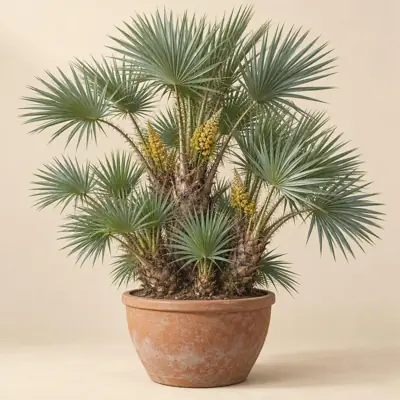
Overview
Chamaerops humilis is a perennial evergreen, shrubby, clumping fan palm that usually produces multiple stems from the base, though removing suckers can give it a single-stemmed appearance.
Origin and habitat
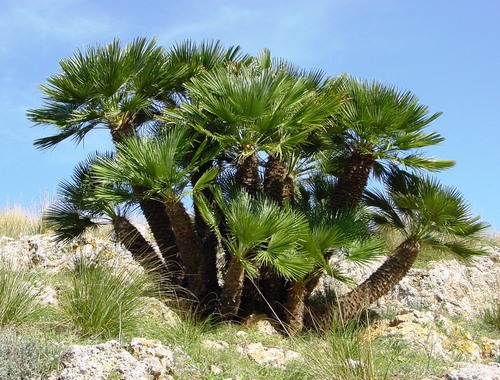
It is native to the western and central Mediterranean region, from southwestern Europe to Italy and in North Africa including Morocco, Algeria, Tunisia, and Libya. It grows mainly in scrub, rocky ground, and hillsides in Mediterranean coastal and near-coastal areas, often in dry, poor, sandy or stony soils. It is adapted to Mediterranean and semi-arid climates, favors hot, dry summers, and has relatively good cold tolerance among palms.
Characteristics
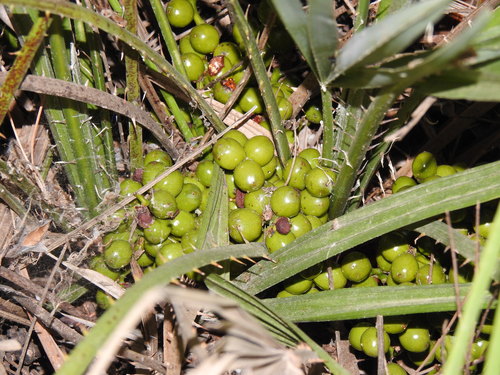
Sources differ on mature height, placing it at about 150–800 cm, while a single source reports a mature spread of about 100–150 cm. Growth is slow, and the stiff, leathery leaves are palmate and fan-shaped, divided into numerous narrow segments, with colors ranging from green to gray-green or blue-green and usually conspicuously spiny petioles. Sources differ in describing the flowers and fruit: mature plants bear small yellow to bright-yellow flowers in short, compact, dense inflorescences, are usually dioecious although sexual expression is not completely fixed, and produce small fleshy fruits that are green when immature and mature in autumn to colors reported from yellow-brown to red-black. A single source reports flowering from spring into early summer.
Light
Sources differ somewhat, but Chamaerops humilis grows well in bright, full-sun conditions and can tolerate partial sun; excessive shade may make its form less compact, while indoor plants benefit from bright light.
Watering
Good drainage is required; water can be supplied moderately during growth, while established plants are drought tolerant. For container plants, watering can wait until the surface medium has dried, with less watering in winter; overwatering may cause root and stem rot.
Temperature and dormancy
Sources differ on minimum temperature tolerance, with limited evidence indicating about -10 °C. Chamaerops humilis is frost hardy. Hardiness classifications are reported for the plant, but the qualitative evidence does not support stating their numerical designations here.
Growing medium and mounting
Chamaerops humilis adapts to a broad range of soils but requires good drainage; loam or sandy, well-drained loam can be used, while wild plants also grow in dry, poor, sandy or rocky soil, and acidic to neutral loam is also recommended.
Feeding
Container plants can receive a balanced fertilizer during growth, while winter water management is reduced.
Propagation
A single source reports that Chamaerops humilis can be propagated from seed or basal suckers.
Common problems
Chamaerops humilis is reported to be susceptible to greenhouse red spider mite, thrips, and scale insects, and it may occasionally be affected by honey fungus. Excessive shade may reduce its compact form, and its many sharp petiole spines require care during contact and handling. It tolerates short periods of low temperatures but is unsuited to frozen roots or repeated freezing over consecutive days; young plants are less cold tolerant than older plants, and container plants in cold areas benefit from shelter and protection from strong winds.
Identification
Typical identifying features include a clumping habit formed by basal suckers, palmate fan-shaped leaves, and spiny petioles; underground rhizomes can continue producing new shoots.
Photos


Sources
- Wikipedia (en): Chamaerops — CC BY-SA 4.0 · link
- Wikipedia (en): Chamaerops humilis — CC BY-SA 4.0 · link
- Wikipedia (de): Zwergpalme — CC BY-SA 4.0 · link
- Wikipedia (fr): Chamaerops humilis — CC BY-SA 4.0 · link
- Wikipedia (es): Chamaerops humilis — CC BY-SA 4.0 · link
- GBIF descriptions: Checklist of introduced taxa in Cyprus; Lista de especies de plantas exóticas y trasplantadas de Col — per dataset · link
- NC State Plant Toolbox: Chamaerops humilis — copyright (facts only) · link
- Useful Tropical/Temperate Plants: Chamaerops humilis — CC BY-NC-SA 3.0 (facts only) · link
- RHS Plants: Chamaerops humilis — © RHS, facts only · link
- Top Tropicals catalog: Chamaerops humilis — © Top Tropicals LLC (facts only) · link