
Areca Palm (Chrysalidocarpus lutescens)
Chrysalidocarpus lutescens is an evergreen, perennial, clumping, multi-stemmed palm with upright stems arising in clusters from the base, forming a shrub-like or small-tree form.
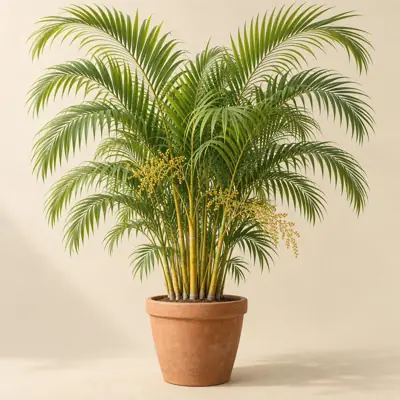
Overview
Chrysalidocarpus lutescens is an evergreen, perennial, clumping, multi-stemmed palm with upright stems arising in clusters from the base, forming a shrub-like or small-tree form.
Origin and habitat
Chrysalidocarpus lutescens is native to Madagascar. In its native range, it is reported mainly from swamps near white sand dunes on Madagascar's east coast and can also occur on alluvial land at higher elevations. It is a tropical plant that can be grown outdoors in tropical and subtropical regions and is usually grown indoors as a foliage plant in temperate regions.
Characteristics
Sources differ on mature size, giving a height of about 400–910 cm and a spread of about 250–460 cm. Sources describe the leaves differently, but they are arching pinnate compound leaves with lance-shaped to linear leaflets; the rachis or midrib may be yellow-green, and the foliage may range from dark green toward yellow-green. The small yellow flowers are borne in branched panicles, with separate male and female flowers, and flowering occurs in summer. The smooth fruits are ovoid to obovoid, initially yellow-orange to orange-yellow and becoming purple-black to black when mature or dry.
Light
Bright indirect light to partial sun is suitable; outdoors it tolerates full sun but prefers partial shade, and excessive exposure may dry the leaves.
Watering
During the growing period, keep the growing medium moist without waterlogging and use a well-drained medium; reduce watering in winter.
Humidity and airflow
Chrysalidocarpus lutescens prefers high humidity.
Temperature and dormancy
A USDA hardiness classification is reported for this species.
Growing medium and mounting
Use well-drained soil that remains moderately moist; a loam-based potting medium is suitable, with acidic to neutral conditions and a preference for slightly acidic conditions also reported.
Feeding
During the growing season, a balanced liquid fertilizer is generally applied.
Propagation
It can be propagated from seed, with seed from mature fruit sown as soon as possible; germination takes a period of months. Sources also report propagation by separating basal divisions with some roots, and recommend warm conditions for sowing.
Common problems
Possible pests include scale insects, whiteflies, spider mites, mealybugs, and thrips. Serious diseases are generally uncommon, although outdoor plants may develop a palm phytoplasma disease spread by planthoppers that causes severe yellowing. Excessive or intense sun exposure may dry the leaves, and sheltered positions are preferred. Indoor plants usually flower or fruit only rarely.
Identification
Key identifying features include multiple bamboo-like stems clustered at the base with conspicuous rings, often yellow-green upper stems, petioles, and rachises, together with upward-arching pinnate leaves.
Photos


Sources
- GBIF Backbone: Chrysalidocarpus lutescens H.Wendl. — CC BY 4.0 · link
- Wikipedia (en): Chrysalidocarpus lutescens — CC BY-SA 4.0 · link
- 維基百科:散尾葵 — CC BY-SA 4.0 · link
- NC State Plant Toolbox: Chrysalidocarpus lutescens — copyright (facts only) · link
- TaiCOL 臺灣物種名錄: Chrysalidocarpus lutescens — CC BY 4.0 · link
- RHS Plants: Chrysalidocarpus lutescens — © RHS, facts only · link
- USDA PLANTS Database: Chrysalidocarpus lutescens — Public domain (US Government work) · link