
chicory (Cichorium intybus)
Cichorium intybus is an upright, branching herb with stout flowering stems that are often grooved and hairy, and it has a deep taproot. Sources differ in describing its life cycle: it is perennial, while some horticultural sources also describe it as capable of being biennial.
Track your chicory in the PLNTverse app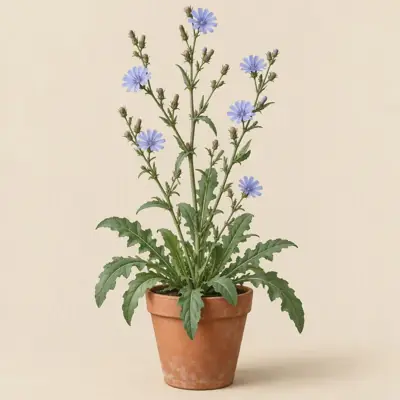
Overview
Cichorium intybus is an upright, branching herb with stout flowering stems that are often grooved and hairy, and it has a deep taproot. Sources differ in describing its life cycle: it is perennial, while some horticultural sources also describe it as capable of being biennial.
Origin and habitat
Sources differ on the native range, describing it as including Europe, North Africa, and western Asia, with some accounts extending the range from the Mediterranean region to Central Asia. It is reported from grassland, pasture, cultivated and fallow land, roadsides, other disturbed environments, gardens, and human-made environments.
Characteristics
Sources differ, with the mature height reported at about 30–200 cm. Basal and lower leaves are reported to be stalked and often toothed or deeply pinnately divided, while upper stem leaves are narrower, ranging from pinnately divided to nearly entire, and are usually stalkless; the leaves are green, and those of wild forms may be rough, hairy, and bitter. The flower heads are reported to be mainly sky blue, pale blue, or blue-violet, with some white or pink forms; the involucral bracts occur in two rows, with the inner row longer and upright and the outer row shorter and spreading outward. Sources differ on flowering records, but flowering is mainly reported from summer into autumn; the fruit is reported to be a brown achene topped by a very short pappus of small scales.
Identification
It is reported to be distinguished by a deep taproot, milky sap, upright stout branching flowering stems, and conspicuous blue flower heads; the flowers commonly open during the day and later close after midday.
Photos


Sources
- Wikipedia (en): Chicory — CC BY-SA 4.0 · link
- Wikipedia (ja): チコリー — CC BY-SA 4.0 · link
- Wikipedia (de): Gemeine Wegwarte — CC BY-SA 4.0 · link
- Wikipedia (fr): Cichorium intybus — CC BY-SA 4.0 · link
- Wikipedia (es): Cichorium intybus — CC BY-SA 4.0 · link
- GBIF descriptions: The checklist of alien seed plants of D.R. Congo, based on evidence from herbarium collections; Data — per dataset · link