
watermelon (Citrullus lanatus)
Citrullus lanatus is an annual herb with creeping or climbing vines.
Overview
Citrullus lanatus is an annual herb with creeping or climbing vines.
Origin and habitat
Sources differ on its native range: it is associated with Africa, while more specific information points to northeastern Africa around Sudan as an important area of origin for modern cultivated watermelon. It occurs along roadsides and in open places in desert regions, while the crop is widely cultivated in gardens, farmland, and other human-made environments. It is suited to tropical through warm-temperate climates and prefers dry, sunny conditions with long, warm summers.
Characteristics
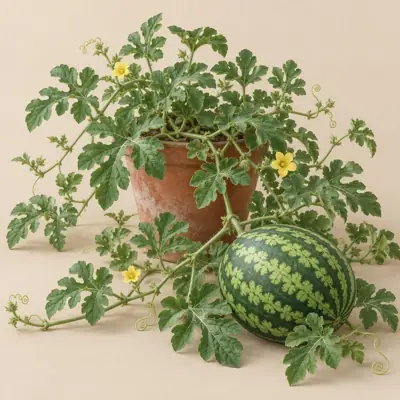
Few sources report a mature height of about 0–50 cm. Sources differ, placing mature spread at about 300–1000 cm. The leaves are reported to be deeply divided and may be divided again, with stiff hairs sometimes present on the leaf surface. The flowers are reported to occur singly in the leaf axils and range from white to yellow; male and female flowers are separate but usually occur on the same plant, with male flowers more abundant earlier in the growing season and female flowers appearing later. The large, fleshy fruits are generally spherical, oval, or elongated, with a smooth, relatively hard rind that is usually green and may be striped or mottled; the flesh is juicy and commonly red or pink, with yellow forms also present, and fruits usually contain many seeds although seedless forms also occur.
Light
Citrullus lanatus prefers full sun and grows better during dry, sunny periods.
Watering
Keep the soil moist but not waterlogged; established plants tolerate drought but not wet soil, and excess water and high humidity may reduce flowering and increase foliar disease.
Humidity and airflow
Citrullus lanatus is reported to prefer low humidity.
Temperature and dormancy
Few sources report a minimum temperature of about 15 °C, an ideal range of about 20–35 °C, and a maximum of about 40 °C.
Growing medium and mounting
It prefers well-drained, organic-rich sandy loam, with a mildly acidic to neutral pH while tolerating a somewhat broader pH range.
Propagation
It is reported to be propagated by seed, sown after the soil has warmed and the risk of frost has passed.
Common problems
It is reported to be affected by mites, vine borers, aphids, stink bugs, cutworms, melon flies, and cucurbit beetles. Reported problems include downy mildew, powdery mildew, bacterial wilt, Fusarium wilt, anthracnose, and blossom-end rot. Waterlogging and excessive humidity are reported to increase foliar disease and impair flowering, while high temperatures may reduce fertilization and yield. It requires warm-season conditions and should be planted after frost risk has passed; cold, rainy weather may interfere with pollination, and excessive moisture can hinder growth, while sufficiently high temperatures may reduce fertilization and yield.
Identification
Citrullus lanatus is an annual creeping vine with tendrils and deeply divided leaves, producing large gourds with smooth rinds and high water content in the flesh.
Photos


Sources
- Wikipedia (en): Watermelon — CC BY-SA 4.0 · link
- 維基百科:西瓜 — CC BY-SA 4.0 · link
- Wikipedia (ja): スイカ — CC BY-SA 4.0 · link
- Wikipedia (de): Wassermelone — CC BY-SA 4.0 · link
- Wikipedia (fr): Pastèque — CC BY-SA 4.0 · link
- Wikipedia (es): Citrullus lanatus — CC BY-SA 4.0 · link
- GBIF descriptions: Manual of the Alien Plants of Belgium; The checklist of alien seed plants of D.R. Congo, based on ev — per dataset · link
- NC State Plant Toolbox: Citrullus lanatus — copyright (facts only) · link
- Useful Tropical/Temperate Plants: Citrullus lanatus — CC BY-NC-SA 3.0 (facts only) · link
- USDA PLANTS Database: Citrullus lanatus — Public domain (US Government work) · link