
Citrus sinensis (Citrus sinensis)
Citrus sinensis is an evergreen shrub to small tree whose branches often bear thorns. It is reported to be perennial.
Overview
Citrus sinensis is an evergreen shrub to small tree whose branches often bear thorns. It is reported to be perennial.
Origin and habitat
Its original source is uncertain; accounts generally point to Asia, possibly southern China and Vietnam, while broader accounts indicate Southeast Asia or Asia. No definite native wild habitat is known, and it is described as an ancient cultivated plant that may have arisen through hybridization or introgression involving Citrus maxima and Citrus reticulata. It is suited to warm temperate, subtropical, and some tropical environments, with commercial cultivation especially associated with subtropical conditions; it requires ample sunlight and is sensitive to frost.
Characteristics
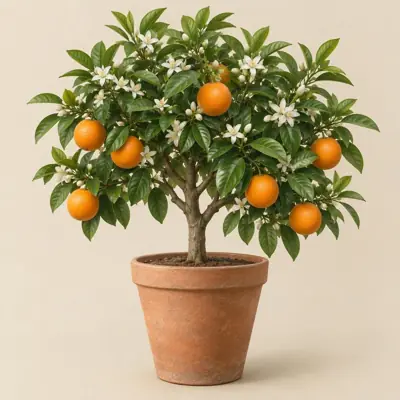
Sources differ on mature height, placing it at about 600–1300 cm, while a single source reports a mature spread of about 100–150 cm. Growth is moderate, and the evergreen leaves are glossy, ovate, and aromatic. The flowers are white and fragrant, with flowering from spring into summer. The fruit is a spherical citrus fruit that is typically orange when mature, with juicy flesh and an aromatic peel that can be used.
Light
It grows in full sun or bright conditions; container-grown plants may receive some shade under intense, hot sunlight.
Watering
During active growth, maintain moderate moisture with good drainage; for container plants, water when the medium approaches dryness, avoiding prolonged waterlogging or complete drying, and reduce watering in winter.
Humidity and airflow
It is generally reported to prefer high humidity.
Temperature and dormancy
A single source gives a lower temperature of about -8.3 °C and an upper temperature of about 38 °C, so sources are few for these values. A single source reports a hardiness-zone range, without broader corroboration here. It is frost tender; keep above freezing.
Growing medium and mounting
It prefers deep, well-drained loam that retains moisture; container media can be loam-based with added drainage material. Sources differ in their descriptions of preferred and tolerated soil acidity, while agreeing that it does not tolerate waterlogging.
Feeding
Citrus-specific fertilizer can be applied throughout the year according to product directions; another source advises avoiding manure in container media.
Propagation
It can be propagated by semi-ripe cuttings in summer, layering in early spring, or sowing in spring. Seed-grown plants are not guaranteed to retain cultivar characteristics.
Common problems
Potential pests include scale insects, mealybugs, greenhouse red spider mites, citrus whiteflies, leaf miners, citrus red mites, and larvae of Papilio cresphontes, which can severely damage sweet orange, especially young trees. Although one account describes disease problems as generally limited, citrus sources list citrus black spot, citrus canker, sweet orange scab, and huanglongbing as diseases that can affect citrus including sweet orange. A single source reports that excessive watering or prolonged lack of water in containers can cause leaf yellowing and even plant death; the roots do not tolerate waterlogging and do not respond well to disturbance. It is sensitive to frost and freezing, and in cold regions overwintering in a greenhouse, sunroom, or movable container is recommended; growth generally stops under sufficiently high temperatures.
Identification
Citrus sinensis is evergreen and often thorny, with fragrant white flowers, glossy leaves, and spherical orange fruit. Sweet orange is described as having a hybrid origin associated with Citrus maxima and Citrus reticulata.
Sources
- GBIF Backbone: Citrus sinensis (Mill.) Pers., 1806 — CC BY 4.0 · link
- Wikipedia (en): Citrus × sinensis — CC BY-SA 4.0 · link
- Useful Tropical/Temperate Plants: Citrus sinensis — CC BY-NC-SA 3.0 (facts only) · link
- RHS Plants: Citrus sinensis — © RHS, facts only · link
- USDA PLANTS Database: Citrus sinensis — Public domain (US Government work) · link
- NC State Plant Toolbox: Citrus (genus-level) — copyright (facts only) · link
- Top Tropicals catalog: Citrus sinensis — © Top Tropicals LLC (facts only) · link