
Canton lemon (Citrus × limon)
Citrus limon is a perennial evergreen shrub to small tree whose branches may bear thorns.
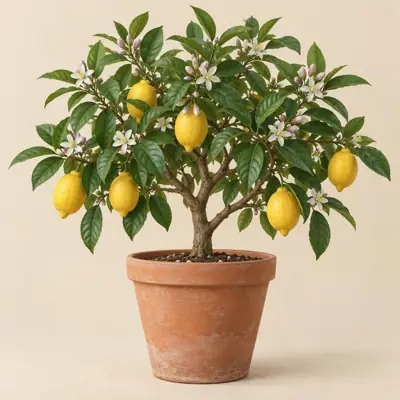
Overview
Citrus limon is a perennial evergreen shrub to small tree whose branches may bear thorns.
Origin and habitat
Sources differ on its original origin, variously placing it in Asia, northwestern India, what is now northeastern India, or, according to TaiCOL, northern Myanmar and southern China. Its original habitat is unknown, and it is now widely cultivated as a fruit tree. It suits warm-temperate to tropical environments and prefers abundant sunlight; in cold regions, container plants may be moved into a greenhouse or indoors for winter protection.
Characteristics
Sources differ on mature height, placing it at about 250–400 cm, while the few available sources report a mature spread of about 100–150 cm. Growth is generally reported to be moderate, with evergreen, glossy, dark-green, elliptical leaves. The fragrant flowers are white to off-white; lemons generally flower mainly from spring to summer, while Eureka is characterized by nearly continuous flowering and fruiting throughout the year. The fruit is yellow and ovoid to pointed-elliptical, with a tough rind and an interior divided into segments containing juice sacs.
Light
Provide full sun or a very bright environment; greenhouse container plants should receive abundant light, with some shade possible under intense light and extreme heat.
Watering
Water thoroughly and regularly during active growth while maintaining good drainage and avoiding waterlogging; container plants can be watered when the growing medium is nearly dry but should not remain completely dry for prolonged periods, and watering should be reduced in winter.
Humidity and airflow
It is generally reported to prefer high humidity.
Temperature and dormancy
Sources differ on the lower temperature guidance, with the limited information placing it at about 4 °C. It is generally reported to have a USDA hardiness-zone classification and to be frost tender; keep above freezing.
Growing medium and mounting
It prefers fertile, well-drained loam; container media may be loam-based with grit added to improve drainage. Reported medium preferences range from acidic conditions to neutral conditions, with The Ferns describing a broader tolerated acidity range and RHS recommending acidic to neutral media.
Feeding
Use a citrus fertilizer throughout the year according to its label; regular feeding of container plants is also recommended.
Propagation
It is reported to be propagated from semi-ripe cuttings in summer, by layering in early spring, or from seed in spring; seedlings do not reliably retain cultivar characteristics.
Common problems
Potential pests include scale insects, mealybugs, greenhouse red spider mites, citrus whiteflies, and leaf miners. Sources differ on disease occurrence: RHS describes disease as generally uncommon, while NC State lists several possible diseases for the genus Citrus. In containers, either overwatering or insufficient watering can cause leaf yellowing and, in severe cases, plant death; the plant also does not tolerate waterlogging or root disturbance. It is sensitive to frost, particularly on tender spring shoots, and sudden exposure to below-freezing conditions without gradual cold acclimation may cause damage.
Identification
Eureka lemon is generally reported to fruit heavily and to grow, flower, and fruit nearly year-round, with continuous fruit production giving rise to the name “Four Seasons.”
Sources
- Wikipedia (en): Lemon — CC BY-SA 4.0 · link
- Wikipedia (en): Citrus limon — CC BY-SA 4.0 · link
- TaiCOL 臺灣物種名錄: Citrus limon — CC BY 4.0 · link
- Useful Tropical/Temperate Plants: Citrus limon — CC BY-NC-SA 3.0 (facts only) · link
- RHS Plants: Citrus limon — © RHS, facts only · link
- USDA PLANTS Database: Citrus limon — Public domain (US Government work) · link
- NC State Plant Toolbox: Citrus (genus-level) — copyright (facts only) · link
- Top Tropicals catalog: Citrus limon — © Top Tropicals LLC (facts only) · link