
Canton lemon (Citrus × limon)
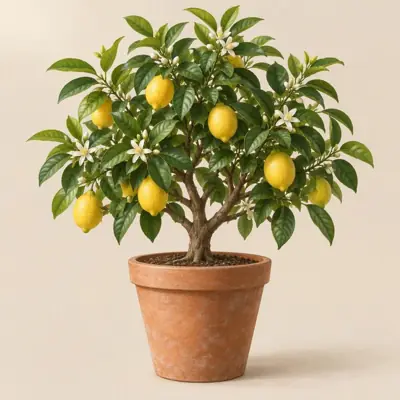
Citrus limon is a perennial evergreen shrub to small tree whose branches may bear thorns; Meyer lemon also occurs in dwarf forms suited to containers.
Overview
Citrus limon is a perennial evergreen shrub to small tree whose branches may bear thorns; Meyer lemon also occurs in dwarf forms suited to containers.
Origin and habitat
It is native to Asia, but sources differ on its precise native range, with some accounts pointing to the region around India and a Taiwan species catalogue recording northern Myanmar and southern China. Its original habitat is reported to be unknown. It is widely cultivated in warm-temperate and tropical regions and generally does not tolerate frost or prolonged cold.
Characteristics
Sources differ on mature height, placing it at about 250–400 cm, while a single source reports a mature spread of about 100–150 cm. It is reported to have a moderate growth rate and glossy, dark green, elliptical evergreen leaves. The fragrant flowers are white to off-white and are reported to appear from spring through summer. The fruit is yellow and ovoid to pointed-ovoid, with a tough rind and an interior divided into segments containing juice sacs; it is acidic.
Light
It grows in full sun to very bright conditions; container plants should receive ample light, with some shade recommended under intensely hot sun.
Watering
During the growing season, water regularly and keep conditions moist but well drained, watering container soil as it approaches dryness without allowing prolonged waterlogging or complete drying; reduce watering in winter.
Humidity and airflow
It is reported to prefer high humidity.
Temperature and dormancy
Sources differ on the minimum temperature, with limited evidence indicating about 4 °C. A single source reports a hardiness classification in the USDA system, while cross-source evidence indicates that Citrus limon tolerates brief light frost.
Growing medium and mounting
It prefers well-drained loam, and container mixes may be loam-based with coarse material added; sources also describe a preference for acidic to neutral conditions and report tolerance across a broader acidity range.
Feeding
A single source reports that citrus-specific fertilizer may be applied throughout the year according to the product label.
Propagation
It can be propagated from semi-ripe cuttings in summer, by layering in early spring, or from seed in spring; seedlings do not reliably retain cultivar characteristics, and commercial citrus is also commonly grafted onto rootstock.
Common problems
Reported pests include scale insects, mealybugs, greenhouse red spider mite, citrus leafminer, citrus whitefly, citrus red mite, and flatid planthoppers. Sources differ on disease problems: one source lists citrus black spot, citrus canker, and sweet orange scab for Citrus, while another describes Citrus limon as generally having few disease problems. A single source reports that either waterlogging or insufficient watering can cause yellowing and even plant death, while root disturbance can also cause growth problems. It is sensitive to frost and sudden temperature drops, with spring shoots remaining frost-sensitive even on mature plants; in cold regions, container growing with winter protection in a greenhouse or indoors is suitable.
Identification
Citrus limon can be recognized by its evergreen, glossy dark green leaves, fragrant white flowers, and citrus fruits that become yellow when mature; dwarf Meyer lemon can be grown in containers.
Sources
- Wikipedia (en): Lemon — CC BY-SA 4.0 · link
- Wikipedia (en): Citrus limon — CC BY-SA 4.0 · link
- GBIF descriptions: Listado de especies de plantas útiles comercializadas en los mercados del distrito de Barranquilla, — per dataset · link
- TaiCOL 臺灣物種名錄: Citrus limon — CC BY 4.0 · link
- Useful Tropical/Temperate Plants: Citrus limon — CC BY-NC-SA 3.0 (facts only) · link
- RHS Plants: Citrus limon — © RHS, facts only · link
- USDA PLANTS Database: Citrus limon — Public domain (US Government work) · link
- NC State Plant Toolbox: Citrus (genus-level) — copyright (facts only) · link
- Top Tropicals catalog: Citrus limon — © Top Tropicals LLC (facts only) · link