
Bleeding Heart Vine / Bleeding Hearts (Clerodendrum thomsoniae)
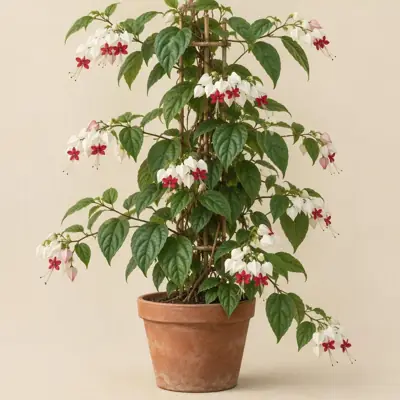
Clerodendrum thomsoniae is an evergreen woody vine or climbing shrub with twining, climbing stems. It is reported to be perennial.
Overview
Clerodendrum thomsoniae is an evergreen woody vine or climbing shrub with twining, climbing stems. It is reported to be perennial.
Origin and habitat
It is native from tropical West Africa into west-central Africa, with more specific accounts extending from Senegal east to Cameroon and some sources extending the range to Nigeria and the Democratic Republic of the Congo. The sources do not provide a clear description of its native habitat; in some areas outside its native range it can escape from gardens and become naturalized, and Central African floristic information records it as a suspected garden escape. It is a tropical plant suited to warm, frost-free conditions and does not tolerate the low winter temperatures of temperate climates.
Characteristics
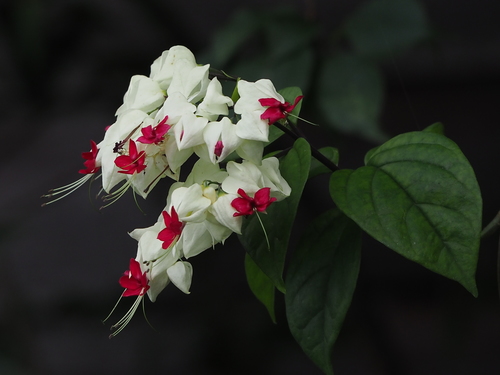
Sources differ on mature size, with height reported at about 250–900 cm; a single source reports a spread of about 100–150 cm. The opposite leaves range from ovate or narrowly ovate to elliptic and usually have entire margins. Sources differ in their descriptions of the flowers: the inflorescences are cymose and commonly arise from the leaf axils, while some sources also describe large terminal inflorescences; the flowers have conspicuous white to pale purple or pink calyces, red to dark-red lobed corollas, and stamens and styles projecting beyond the corolla. Flowering occurs mainly in spring and summer; Taiwan sources also record flowering from early summer into late autumn, while under suitable tropical cultivation it may flower throughout the year, and the fruit is generally reported to become black or red and black when mature, with red structures and persistent calyces that can turn red to pink.
Light
It grows in full sun to partial sun; horticultural sources favor ample light, with greenhouse cultivation allowing full light while avoiding intense direct summer sun. Insufficient light can cause elongated growth, smaller and paler leaves, and failure to flower.
Watering
Sources differ somewhat on watering: water demand is higher during growth and flowering, when the soil should be kept moist, while horticultural sources also recommend a moist but well-drained medium. Watering should be reduced in winter, and mature plants can tolerate some dryness.
Temperature and dormancy
Sources differ on the lower temperature threshold, placing it at about 10 °C.
Growing medium and mounting
It prefers moist, fertile, well-drained soil and can adapt to clay, loam, or sandy soil with acidic, neutral, or alkaline conditions.
Feeding
A single horticultural source recommends increased nitrogen feeding early in growth, followed from spring by a flowering fertilizer higher in phosphorus and potassium, applied periodically.
Propagation
It can be propagated by seed, semi-hardwood stem cuttings, root cuttings, and suckers. Taiwan sources also describe taking stem cuttings in spring or pressing stems into the soil to encourage rooting.
Common problems
It is reported to be susceptible to mealybugs, greenhouse red spider mites, and greenhouse whiteflies, while Armillaria disease is also reported but noted by the RHS as uncommon. Insufficient light can produce weak, elongated growth, smaller pale leaves, and failure to flower, while in some areas outside its native range the plant can escape cultivation and become naturalized. It does not tolerate frost or low temperatures and, in temperate regions, requires sheltered, frost-free conditions for overwintering; sufficiently low temperatures can cause leaf drop or death.
Identification
Clerodendrum thomsoniae is distinguished by conspicuous white calyces surrounding or setting off dark-red corollas, creating a strong red-and-white contrast, with slender stamens projecting beyond the corolla; the plant is an evergreen climbing vine.
Photos


Sources
- Wikipedia (en): Clerodendrum thomsoniae — CC BY-SA 4.0 · link
- Wikipedia (ja): ゲンペイクサギ — CC BY-SA 4.0 · link
- Wikipedia (fr): Clérodendron grimpant — CC BY-SA 4.0 · link
- Wikipedia (es): Clerodendrum thomsoniae — CC BY-SA 4.0 · link
- GBIF descriptions: Lista de especies de plantas exóticas y trasplantadas de Colombia; Catálogo de Plantas y Líquenes de — per dataset · link
- 農業知識入口網 植物圖鑑: Clerodendrum thomsoniae — © MOA, facts only · link
- Useful Tropical/Temperate Plants: Clerodendrum thomsoniae — CC BY-NC-SA 3.0 (facts only) · link
- RHS Plants: Clerodendrum thomsoniae — © RHS, facts only · link
- USDA PLANTS Database: Clerodendrum thomsoniae — Public domain (US Government work) · link