
garden croton (Codiaeum variegatum)
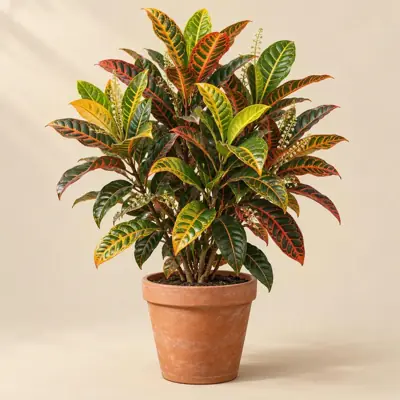
Codiaeum variegatum is a perennial evergreen woody shrub to small tree and is commonly grown indoors as a foliage plant.
Overview
Codiaeum variegatum is a perennial evergreen woody shrub to small tree and is commonly grown indoors as a foliage plant.
Origin and habitat
Sources differ on the exact native range, but describe it as extending mainly from the Malay Archipelago and islands of Southeast Asia eastward to New Guinea, Queensland in Australia, and western Pacific islands, including the Philippines, Borneo, Java, Sulawesi, the Moluccas, the Bismarck Archipelago, the Solomon Islands, Vanuatu, and Fiji. It is reported to occur naturally in mature rainforest understories from lowlands to higher ground, more often in relatively dry rainforest types, and can grow in soils formed from recent basalt. It is reported to be a tropical plant adapted to warm conditions and is widely cultivated as an ornamental in tropical and subtropical regions.
Characteristics
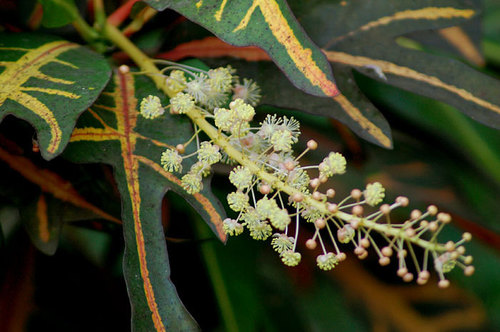
Sources differ on mature size, with a reported height of about 91.44–300 cm. Sources differ in their descriptions of the leaves, which are thick, leathery, glossy, and usually alternate, with highly variable shapes among cultivars and patterns or contrasting veins in green, yellow, orange, red, pink, and purple. The plant is monoecious with separate male and female flowers borne in slender racemes; male flowers are white, female flowers are yellowish and generally described as lacking petals, and the flowers are inconspicuous compared with the foliage. Flowering is reported to occur generally in early autumn, with timing varying by location, and the fruit is reported to be a nearly spherical capsule containing seeds.
Light
Codiaeum variegatum prefers full sun to partial sun and bright light indoors; stronger light supports vivid leaf color, while insufficient light may cause the color to fade.
Watering
During the growing season, water regularly while keeping the soil moderately moist but well drained; watering can be more generous from spring through autumn and reduced in winter, and some sources recommend watering after the soil surface has dried.
Humidity and airflow
Codiaeum variegatum is generally reported to prefer moderate humidity.
Temperature and dormancy
Sources differ or are few regarding the lower temperature threshold, which is reported at about 15 °C. Sources differ on the suitable USDA hardiness zones for outdoor overwintering. It is generally reported to tolerate brief light frost.
Growing medium and mounting
It grows in well-drained, humus-rich soil that retains moderate moisture.
Feeding
It is reported to need more frequent feeding during the growing season, mainly in spring and summer, although one source cautions against an excessively fertile growing medium.
Propagation
It is reported to be propagated in spring by cuttings or air layering, as well as by seed, with a warm greenhouse environment recommended by the relevant source.
Common problems
Reported pests include two-spotted spider mite and greenhouse thrips. Insufficient light can fade leaf color, overly dry conditions can cause progressive yellowing and leaf drop, and low temperatures may cause leaves to droop or fall. The plant is sensitive to low temperatures, with cold conditions capable of causing leaf drop; it is suited to persistently warm conditions and generally requires indoor or greenhouse overwintering in cooler regions.
Identification
Codiaeum variegatum is distinguished by thick, glossy, highly variable leaves with vivid variegation in green, yellow, red, purple, orange, and pink; leaf shape and color vary greatly among cultivars.
Photos


Sources
- Wikipedia (en): Codiaeum variegatum — CC BY-SA 4.0 · link
- 維基百科:變葉木 — CC BY-SA 4.0 · link
- Wikipedia (ja): ヘンヨウボク — CC BY-SA 4.0 · link
- Wikipedia (de): Kroton (Pflanze) — CC BY-SA 4.0 · link
- Wikipedia (fr): Codiaeum variegatum — CC BY-SA 4.0 · link
- Wikipedia (es): Codiaeum variegatum — CC BY-SA 4.0 · link
- GBIF descriptions: Lista de especies de plantas exóticas y trasplantadas de Colombia; Catálogo de Plantas y Líquenes de — per dataset · link
- NC State Plant Toolbox: Codiaeum variegatum — copyright (facts only) · link
- Wikipedia (it): Codiaeum variegatum — CC BY-SA 4.0 · link
- Wikipedia (pt): Codiaeum variegatum — CC BY-SA 4.0 · link
- Wikipedia (ko): 크로톤 (식물) — CC BY-SA 4.0 · link
- Useful Tropical/Temperate Plants: Codiaeum variegatum — CC BY-NC-SA 3.0 (facts only) · link
- USDA PLANTS Database: Codiaeum variegatum — Public domain (US Government work) · link
- Top Tropicals catalog: Codiaeum variegatum — © Top Tropicals LLC (facts only) · link