
Columnea gloriosa (Columnea gloriosa)
Columnea gloriosa is a perennial herbaceous vine with stems that can trail, making it suitable for growing in a hanging form. It is reported to be perennial.
Overview
Columnea gloriosa is a perennial herbaceous vine with stems that can trail, making it suitable for growing in a hanging form. It is reported to be perennial.
Origin and habitat
It is native to the Caribbean, Central America, and tropical regions of South America. In its native habitat, it is reported to grow on tree trunks or rocks. Its native environment is warm, humid, and tropical.
Characteristics
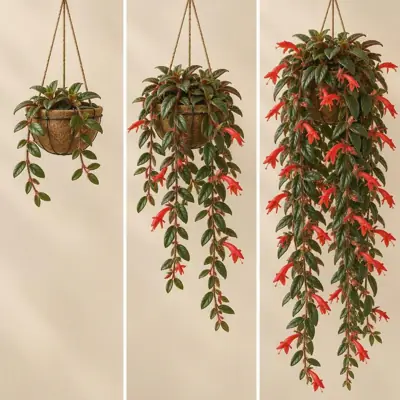
The leaves are reported to be dark green, thick, and waxy, with an oblanceolate shape and possible red hairs. Sources differ in describing the flowers; they are described as red, slender, tubular, and resembling leaping fish. Sources differ on the flowering season, which is described as extending from spring into summer.
Light
Bright indirect light or partial shade is suitable, while strong direct sunlight should be avoided because it can scorch the leaves.
Watering
During the growing season, keep the medium moderately moist while allowing it time to dry between waterings; avoid excessively wet conditions combined with high temperatures, which can cause the trailing stems to rot.
Temperature and dormancy
A minimum temperature of about 10 °C is reported, based on few sources. The reported ideal temperature is about 18–24 °C, but sources differ.
Growing medium and mounting
A loose, fertile, well-drained, well-aerated sandy loam or similar medium is generally recommended.
Feeding
During vigorous growth, fertilizer is reported to be applied regularly, with phosphorus and potassium fertilizer used alongside pruning after flowering.
Propagation
Propagation is reported to be possible by seed, cuttings, or division, with cuttings being the main method. Tip shoots can be used as cuttings, with spring and autumn described as more suitable times and a clean, moisture-retentive environment supporting rooting; division can be carried out when repotting.
Common problems
Insufficient light or humidity may cause lower leaves to drop, while direct sunlight may scorch the leaves. Hot, excessively humid conditions may cause trailing stems to rot, and some varieties may also lose leaves in midsummer. The plant is sensitive to strong direct sunlight and hot, excessively humid conditions, and overwintering conditions should remain above the stated minimum temperature threshold.
Identification
It is generally identified by red, slender, tubular, fish-shaped flowers and oblanceolate leaves with red hairs.
Photos

