
coriander (Coriandrum sativum)
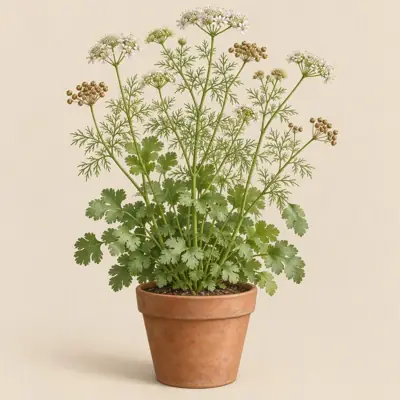
Coriandrum sativum is an upright, branching annual herbaceous plant.
Overview
Coriandrum sativum is an upright, branching annual herbaceous plant.
Origin and habitat
Sources differ on the precise native range, but generally place it around the Mediterranean region from southern Europe to North Africa, with some accounts pointing more specifically to the eastern Mediterranean and Asia Minor. It occurs in cultivated settings such as fields and vegetable gardens, as well as wasteland, near riverbanks, in grassland and tall-herb communities, and along woodland edges and in clearings. It can be cultivated from temperate to tropical climates, prefers a cooler growing season, and in tropical regions can grow below a reported elevational limit.
Characteristics
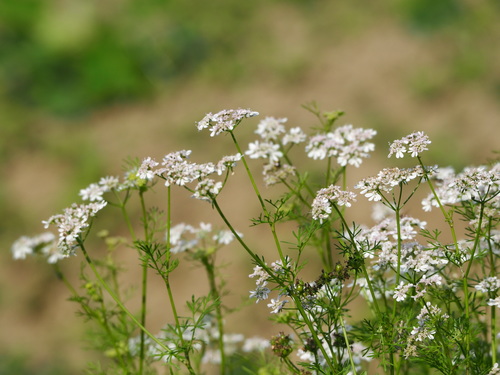
Sources differ on mature height, placing it at about 30–90 cm, while the few available sources report a mature spread of about 20–30 cm. The aromatic leaves change markedly in form up the plant: lower or younger leaves are broader and shallowly lobed or pinnately divided, while upper leaves become progressively narrower, linear to feathery. Small white to pale pink or purplish flowers form compound umbels; outer petals may be larger, giving the flowers a slightly asymmetrical form, and flowering occurs from spring into summer, with some horticultural accounts extending it into early autumn. Sources differ in descriptions of the aromatic, nearly spherical dry fruit, and a single source reports that germination is followed by a later transplanting stage and still later leaf harvest.
Light
It grows in full sun to partial shade; abundant sun is preferred when producing seed, while plants grown for leaves can also produce well in partial shade.
Watering
Keep conditions moderately moist but well drained, avoiding prolonged waterlogging or consistently excessive moisture; the surface soil can become slightly dry before watering again.
Humidity and airflow
It is generally reported to prefer low humidity.
Temperature and dormancy
Sources are few; an ideal temperature range is reported at about 15–25 °C, with a reported minimum of about -10 °C and maximum of about 32 °C. Sources differ on the reported hardiness-zone classification. It is generally reported to tolerate brief light frost.
Growing medium and mounting
It grows in fertile, well-drained soil and can adapt to loam, sand, and chalky soils under acidic, neutral, or alkaline conditions; another source favors warm, dry, lighter-textured soil.
Feeding
It is generally recommended to avoid excessive nitrogen fertilizer.
Propagation
It is propagated from seed, which may be sown in seedling trays or directly in the ground, and it may also self-sow.
Common problems
Aphids may attack the plant, including Hyadaphis coriandri, and powdery mildew is also reported. Hot conditions can cause rapid bolting; persistently wet conditions and excessive nitrogen can hinder growth, while plants that become too dry may set seed sooner. It prefers a cool growing season and bolts readily in high temperatures; mature plants can briefly tolerate light frost, but extremely low temperatures may be fatal.
Identification
The whole plant has a strong, distinctive aroma; lower leaves are broader while upper leaves are finely divided, and the compound umbels bear white to pale pink flowers.
Photos


Sources
- GBIF Backbone: Coriandrum sativum L. — CC BY 4.0 · link
- Wikipedia (en): Coriander — CC BY-SA 4.0 · link
- 維基百科:芫荽 — CC BY-SA 4.0 · link
- Wikipedia (ja): コリアンダー — CC BY-SA 4.0 · link
- Wikipedia (de): Echter Koriander — CC BY-SA 4.0 · link
- Wikipedia (fr): Coriandre — CC BY-SA 4.0 · link
- Wikipedia (es): Coriandrum sativum — CC BY-SA 4.0 · link
- GBIF descriptions: Manual of the Alien Plants of Belgium; Checklist of introduced taxa in Cyprus; Database of Vascular — per dataset · link
- NC State Plant Toolbox: Coriandrum sativum — copyright (facts only) · link
- Wikipedia (it): Coriandrum sativum — CC BY-SA 4.0 · link
- Wikipedia (nl): Koriander — CC BY-SA 4.0 · link
- Wikipedia (pt): Coentro — CC BY-SA 4.0 · link
- Wikipedia (ko): 고수 (식물) — CC BY-SA 4.0 · link
- TaiCOL 臺灣物種名錄: Coriandrum sativum — CC BY 4.0 · link