
Redspot Stonecrop (Crassula capitella)
Crassula capitella is a small succulent herb to subshrub whose stems may be upright or creeping, forming mat-like colonies and rooting at the nodes. Sources differ on its life cycle: depending on form, it may be perennial or biennial, with some forms mostly biennial and flowering rosettes potentially dying after flowering.
Overview
Crassula capitella is a small succulent herb to subshrub whose stems may be upright or creeping, forming mat-like colonies and rooting at the nodes. Sources differ on its life cycle: depending on form, it may be perennial or biennial, with some forms mostly biennial and flowering rosettes potentially dying after flowering.
Origin and habitat
Sources differ on the precise native range, but place it in southern Africa, mainly South Africa and extending into southern Namibia and Botswana, with Transvaal, the Free State, and Eastern Cape specifically listed. The species and its subspecies occur in varied southern African habitats; some forms grow on coastal sands, while others occur in grassland, gravelly slopes, or rocky hills.
Characteristics
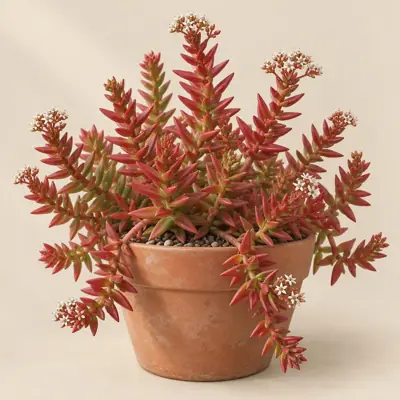
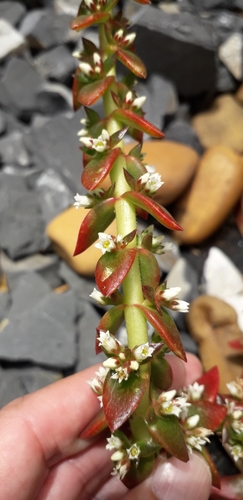
Mature plants reach 15–40 cm in height. Growth is reported to be moderately fast, and the plant generally stores water in several organs. The succulent leaves are narrow-lanceolate to oblong-ovate with pointed tips, arranged in pairs in stacked or rosette-like patterns; they are usually green but may turn red to orange-red under conditions including strong light and low temperatures. The small white, star-shaped or nearly star-shaped flowers are concentrated in spike-like terminal inflorescences; sources differ on flowering season, with species accounts mainly indicating summer and horticultural accounts for 'Campfire' indicating autumn to winter, while a single source gives a mature spread of about 0–100 cm and sources are few.
Light
Crassula capitella does well in bright conditions from full sun to partial sun and takes full sun; ample sunlight helps the leaves develop orange-red to red coloration, but overly strong direct light during the hottest part of summer should be avoided, and abruptly moving a plant from shade into strong light may cause sunburn.
Watering
Water after the growing medium has dried; during active growth, water may be supplied regularly without allowing waterlogging, while watering should be reduced in winter or cool conditions to avoid persistently cold, wet medium.
Humidity and airflow
It is generally reported to prefer low humidity and need good airflow.
Temperature and dormancy
Sources differ on the lower temperature threshold, placing it around 0 °C, while another specialist source gives about 5 °C and sources are few. It is reported to tolerate brief light frost and to have no marked dormancy. A specialist source reports a USDA hardiness zone for the plant. It is weaker in hot, humid conditions, and direct sun should be avoided during the hottest part of summer.
Growing medium and mounting
Use a well-drained, sandy or gravelly succulent growing medium and avoid prolonged waterlogging; the plant needs a fast-draining mix. It is generally reported to be prone to rot.
Feeding
Fertilizer should be used moderately; reported practices include low-nitrogen succulent fertilizer during the growing season and small amounts of slow-release or liquid fertilizer.
Propagation
Propagation methods include seed, stem cuttings, leaf cuttings, and division. A source reports that stem cuttings can be used and that leaf cuttings can also root and sprout, although more slowly.
Common problems
Mealybugs and scale insects may affect the plant. Poor drainage or prolonged cold, wet conditions may lead to root rot, while cultivation information for Crassula also lists rust, black spot, and soft rot. Rapid changes in moisture conditions may cause leaf edema, deep shade may produce elongated growth, abruptly moving a plant from shade into full sun may cause sunburn, and persistently cold, wet winter medium may cause root loss. It does not tolerate frost and should also be protected from prolonged rain, hot and humid conditions, and the strongest direct sunlight in midsummer.
Identification
Narrow, pointed leaves are stacked along the stems and can change from green to conspicuous red or orange-red in ample sunlight; 'Campfire' is described as a horticultural form with longer leaves.
Photos



Sources
- Wikipedia (en): Crassula capitella — CC BY-SA 4.0 · link
- Wikipedia (fr): Crassula capitella — CC BY-SA 4.0 · link
- Wikipedia (es): Crassula capitella — CC BY-SA 4.0 · link
- 農業知識入口網 植物圖鑑: Crassula capitella — © MOA, facts only · link
- LLIFLE Encyclopedia of living forms: Crassula capitella — CC BY-SA · link
- Desert-Tropicals: Crassula capitella — © Philippe Faucon (desert-tropicals.com), facts only · link
- The Succulent Plant Page: Crassula (genus-level) — © R.J. Hodgkiss, facts only · link
- NHK みんなの趣味の園芸 植物図鑑: Crassula capitella — © NHK出版, facts only · link
- PUKUBOOK: Crassula capitella — CC BY-NC (facts only) · link