
toy-cypress (Crassula muscosa)
Crassula muscosa is a densely growing, branching, shrubby perennial succulent with stems that may creep, grow obliquely, or be nearly upright.
Overview
Crassula muscosa is a densely growing, branching, shrubby perennial succulent with stems that may creep, grow obliquely, or be nearly upright.
Origin and habitat
Sources differ on the native-range description, which includes South Africa and Namibia, with records across several parts of South Africa and extending into southern Namibia. It occurs in semi-arid to arid parts of the Karoo in southern Africa, favoring rocky settings but also occurring on flats, and is described as growing in well-drained soil. Its native environment includes semi-arid to arid climates, while cultivation information indicates a need for good drainage and an ability to grow under moderately moist conditions.
Characteristics
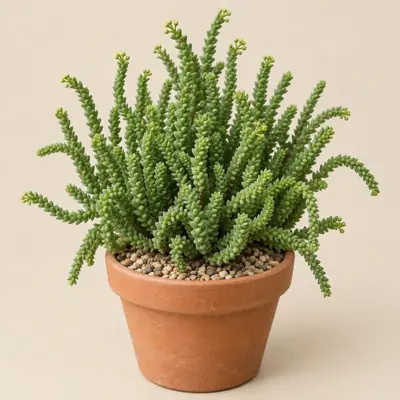
Sources differ on mature size, placing height at about 10–40 cm, while the few sources for spread report about 10–50 cm. It is reported to grow relatively slowly and to store water in its leaves. The very small leaves are densely overlapping, usually arranged in rows, and are ovate to triangular and fleshy to leathery; their color ranges from green and yellow-green to gray or brown, and their dense arrangement gives the stems a square or angular appearance. The very small flowers usually arise along the stems or in the leaf axils and are mainly pale yellow-green to yellow-green, though sources differ and also record brown or nearly white flowers; sources also differ in describing flowering from spring into summer.
Light
Crassula muscosa takes bright light or part shade; accounts range from full sun to filtered light and partial sun, and sources differ on its adaptation to intense sunlight. Indoors, bright light is recommended.
Watering
Use a well-drained medium and provide moderate water during active growth, with more regular watering possible in summer and reduced watering in winter or dormancy while avoiding prolonged wetness. Some cultivation sources recommend watering thoroughly and then waiting for the medium to dry before watering again.
Humidity and airflow
It is reported to prefer moderate humidity and to need good airflow.
Temperature and dormancy
The few available sources report a minimum temperature of about 6 °C, while a separate minimum estimate is about 0 °C. Sources differ in their hardiness-zone descriptions. It is reported to be frost tender and should be kept above freezing. It is reported that excessive summer sun can damage the plant, with drying and hardening beginning at the stem base and gradually extending toward the tip.
Growing medium and mounting
Crassula muscosa needs a fast-draining mix; suitable media are described as mineral-rich soil, standard cactus potting mix, or fertile soil combined with sandy material. It is reported to be prone to rot.
Feeding
Small amounts of fertilizer may be applied during the growing season; sources describe either balanced liquid fertilizer or diluted succulent fertilizer and advise against excessive feeding.
Propagation
Propagation methods include seed, stem cuttings, softwood cuttings, and leaf cuttings, with stem cuttings described as rooting readily. Seed may be sown in early spring, while softwood or leaf cuttings may be taken in spring or summer.
Common problems
Possible pests include mealybugs, aphids, and weevils. It is generally described as having few disease problems, though fungal problems may become more likely with overwatering, poor airflow, or excessive vegetative growth caused by feeding. Unsuitable light, humidity, or temperature may cause drying and hardening to progress from the stem base toward the tip, while poor drainage and excessive watering should be avoided. Sources differ on weather sensitivity: freezing should be avoided and intense direct sun in hot summers may cause stress, although some accounts indicate a degree of short-term cold tolerance.
Identification
Slender branching stems are densely covered with very small, scale-like leaves arranged in rows, giving the branches a square, angular, or chain-like appearance and an overall look reminiscent of moss or clubmoss.
Photos


Sources
- Wikipedia (en): Crassula muscosa — CC BY-SA 4.0 · link
- Wikipedia (fr): Crassula muscosa — CC BY-SA 4.0 · link
- Wikipedia (es): Crassula muscosa — CC BY-SA 4.0 · link
- GBIF descriptions: Chapter 7: Linnaean Plant Names and their Types (part C) — per dataset · link
- LLIFLE Encyclopedia of living forms: Crassula muscosa — CC BY-SA · link
- RHS Plants: Crassula muscosa — © RHS, facts only · link
- The Succulent Plant Page: Crassula (genus-level) — © R.J. Hodgkiss, facts only · link
- NHK みんなの趣味の園芸 植物図鑑: Crassula (genus-level) — © NHK出版, facts only · link
- Top Tropicals catalog: Crassula muscosa — © Top Tropicals LLC (facts only) · link
- PUKUBOOK: Crassula muscosa — CC BY-NC (facts only) · link
- Crassula muscosa - Watch Chain | Mountain Crest Gardens™ (mountaincrestgardens.com) — facts only (§12) · link
- Crassula muscosa | Giromagi cactus and succulents for sale | Buy plants online (www.giromagi.com) — facts only (§12) · link