
jade plant (Crassula ovata)
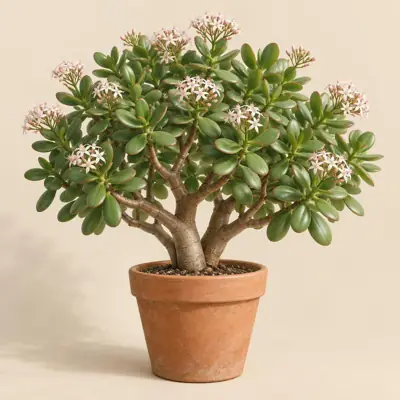
Crassula ovata is a perennial, evergreen, succulent shrub or subshrub with an upright to spreading, highly branched habit, often becoming tree-like when mature.
Overview
Crassula ovata is a perennial, evergreen, succulent shrub or subshrub with an upright to spreading, highly branched habit, often becoming tree-like when mature.
Origin and habitat
Sources differ on its native range in southern Africa, principally including South Africa's Eastern Cape and KwaZulu-Natal and Mozambique. It grows on rocky slopes, hills and fields, among shrubs in open woodland, in soils that can include sandy clay, and in more sheltered ravines. Its native environments include warm, rocky areas characterized by winter rainfall, and the plant tolerates heat, drought and some wind.
Characteristics
Sources differ on mature height, placing it at about 150–300 cm, while a single source reports a mature spread of about 100–150 cm. It grows slowly and stores water in its leaves. The opposite, fleshy, smooth, glossy leaves are mainly obovate to elliptic and usually jade green to dark green, often with red margins that become more pronounced in strong light in some varieties. Mature plants can produce many small, star-shaped, white to pale pink flowers, often clustered at branch tips; sources differ in describing flowering as mainly in winter, with cooler winter months recorded for South Africa, and a single source reports follicles containing many very tiny seeds.
Light
Crassula ovata prefers full sun or a very bright position and takes full sun; sources differ, with some cultivation information recommending some afternoon shade. Indoors, a bright, well-ventilated position is preferred, and light should be increased gradually because moving suddenly from shade into strong light can damage the leaves.
Watering
It is drought tolerant; water thoroughly after the growing medium dries and avoid prolonged wetness, with more normal watering during spring and summer growth and reduced watering from autumn into winter, keeping it relatively dry in winter.
Humidity and airflow
It is generally reported to prefer low humidity and needs good airflow.
Temperature and dormancy
A single source reports a lower temperature of about 0 °C, while sources differ on an ideal range of about 15–24 °C. It is generally reported to be frost tender; keep above freezing, and it rests in winter. In excessively hot or dry weather it may shed leaves to reduce water loss, and it performs less well in hot, humid conditions.
Growing medium and mounting
Use a well-drained potting medium, such as a well-drained medium containing more loam or a cactus and succulent mix; it can adapt to acidic, neutral or alkaline pH. It is prone to rot and needs a fast-draining mix.
Feeding
From spring through summer, a general liquid fertilizer can be applied monthly; another source recommends a small amount of slow-release compound fertilizer or liquid fertilizer in spring.
Propagation
It can be propagated by leaf and stem cuttings, with seed, offsets and root propagation also recorded; leaves can form adventitious roots and shoots. Division is also a reported propagation method.
Common problems
Possible pests include mealybugs, aphids, scale insects, spider mites and vine weevils. Sources differ on reported disease problems: excess moisture is associated with root rot, while rust, scab and soft rot are also listed. A single source reports that overwatering can cause leaf drop and rot, extreme water shortage can cause damage, sudden large increases in light can injure leaves, excessively strong sunlight can cause leaf drop or sunburn, and insufficient light can hinder flowering. It is sensitive to frost and freezing and is unsuited to prolonged hot, humid or cold, wet conditions; in dry growing medium it can briefly tolerate temperatures near freezing.
Identification
Sources differ in their descriptions, but distinguishing features include thick, fleshy opposite leaves with often-red margins and stout, succulent, highly branched stems; young stems are green to gray-green, while older stems gradually turn brown and trunk-like.
Photos


Sources
- Wikipedia (en): Crassula ovata — CC BY-SA 4.0 · link
- 維基百科:翡翠木 — CC BY-SA 4.0 · link
- Wikipedia (ja): カネノナルキ — CC BY-SA 4.0 · link
- Wikipedia (de): Geldbaum — CC BY-SA 4.0 · link
- Wikipedia (fr): Crassula ovata — CC BY-SA 4.0 · link
- Wikipedia (es): Crassula ovata — CC BY-SA 4.0 · link
- GBIF descriptions: DAISIE - Inventory of alien invasive species in Europe — per dataset · link
- NC State Plant Toolbox: Crassula ovata — copyright (facts only) · link
- LLIFLE Encyclopedia of living forms: Crassula ovata — CC BY-SA · link
- RHS Plants: Crassula ovata — © RHS, facts only · link
- USDA PLANTS Database: Crassula ovata — Public domain (US Government work) · link
- The Succulent Plant Page: Crassula (genus-level) — © R.J. Hodgkiss, facts only · link
- NHK みんなの趣味の園芸 植物図鑑: Crassula ovata — © NHK出版, facts only · link
- Top Tropicals catalog: Crassula ovata — © Top Tropicals LLC (facts only) · link