
jade plant (Crassula ovata)
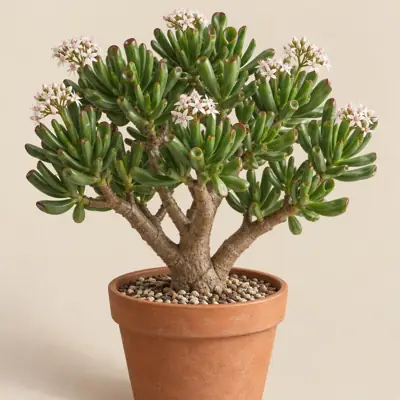
Crassula ovata is a perennial, evergreen, succulent shrub or subshrub with an upright to spreading, freely branching habit.
Overview
Crassula ovata is a perennial, evergreen, succulent shrub or subshrub with an upright to spreading, freely branching habit.
Origin and habitat
Sources differ on its native range, which is centered in southern Africa and includes parts of South Africa and Mozambique. It occurs on rocky slopes, hills, fields, and among shrubs in open woodland, including sheltered gullies; some sources describe sandy clay soils. It is adapted to relatively warm, dry, well-drained conditions and does not tolerate prolonged hot, humid conditions or cold, wet conditions well.
Characteristics
Sources differ on mature height, placing it at about 150–300 cm, while a limited source reports a mature spread of about 100–150 cm; growth is slow. The opposite, fleshy, smooth, glossy leaves are usually jade green and range from obovate to elliptic or spoon-shaped, with margins that may redden on some plants or under strong light; the plant stores water in several organs. Small, star-shaped flowers ranging from white to pale pink are borne in clusters at branch tips; sources differ on flowering season, with accounts ranging from cooler periods to other parts of the year. The fruit is reported to be a follicle containing many small seeds.
Light
Sources differ somewhat on light conditions: Crassula ovata takes full sun and can be grown in bright light to full sun, with a sunny indoor position or afternoon shade also described. When moving it from lower light into strong light, gradual acclimation is advised to reduce leaf scorch or leaf drop.
Watering
Crassula ovata is drought tolerant and should not be overwatered; water after the growing medium dries, provide moderate water during active growth, and reduce watering markedly in winter. Standing water or excessive moisture in cold conditions can promote rot.
Humidity and airflow
It is generally reported to prefer low humidity and to need good airflow.
Temperature and dormancy
Sources differ around a minimum of about 0 °C, and limited sources place ideal temperatures at about 15–24 °C; Crassula ovata is generally reported to be frost tender and should be kept above freezing. A USDA hardiness zone is reported, and Crassula ovata rests in winter. It is weaker under hot, humid conditions and may drop leaves when conditions are too hot or too dry, reducing water loss.
Growing medium and mounting
Use a porous, well-drained growing medium; cactus or succulent mixes are suitable, and sources also mention loam-based media. Crassula ovata is prone to rot and needs a fast-draining mix.
Feeding
Fertilizer may be applied during active growth from spring through summer; sources describe either regular general liquid feeding or small applications of slow-release chemical fertilizer or liquid fertilizer in spring.
Propagation
Crassula ovata can be propagated by leaf cuttings, stem cuttings, root cuttings, division, or seed, and its leaves can form adventitious roots and new shoots.
Common problems
Potential pests include mealybugs, weevils, and aphids. Sources differ on disease problems: one account reports no significant disease problems, while overwatering can cause rot, leaf drop, or both, and extreme lack of water may also cause damage. A sudden move into intense sun or excessive sun can cause leaf scorch, damage, or leaf drop, while insufficient light may inhibit flowering. It is sensitive to frost and prolonged hot, humid conditions; freezing and prolonged exposure to rain should be avoided, while brief cold conditions are better tolerated when conditions are dry.
Identification
Crassula ovata has thick, fleshy leaves and succulent branches, developing a small tree-like form when mature; young branches are green and gradually become brown in appearance as they age.
Photos


Sources
- Wikipedia (en): Crassula ovata — CC BY-SA 4.0 · link
- 維基百科:翡翠木 — CC BY-SA 4.0 · link
- Wikipedia (ja): カネノナルキ — CC BY-SA 4.0 · link
- Wikipedia (de): Geldbaum — CC BY-SA 4.0 · link
- Wikipedia (fr): Crassula ovata — CC BY-SA 4.0 · link
- Wikipedia (es): Crassula ovata — CC BY-SA 4.0 · link
- GBIF descriptions: DAISIE - Inventory of alien invasive species in Europe — per dataset · link
- NC State Plant Toolbox: Crassula ovata — copyright (facts only) · link
- LLIFLE Encyclopedia of living forms: Crassula ovata — CC BY-SA · link
- RHS Plants: Crassula ovata — © RHS, facts only · link
- USDA PLANTS Database: Crassula ovata — Public domain (US Government work) · link
- The Succulent Plant Page: Crassula (genus-level) — © R.J. Hodgkiss, facts only · link
- NHK みんなの趣味の園芸 植物図鑑: Crassula ovata — © NHK出版, facts only · link
- Top Tropicals catalog: Crassula ovata — © Top Tropicals LLC (facts only) · link