
Montbretia (Crocosmia × crocosmiiflora)
Crocosmia crocosmiiflora is a perennial herbaceous plant.
Overview
Crocosmia crocosmiiflora is a perennial herbaceous plant.
Origin and habitat
Sources differ on its origin; it is described as a horticultural hybrid bred in France by Victor Lemoine from C. aurea and C. pottsii. Naturalized or escaped populations are recorded from coastal and inland waterside environments, riverbanks and marshy scrub, sparsely vegetated areas, agricultural and horticultural land, artificial environments, areas around transport infrastructure, and waste sites; it also occurs in varied environments in Belfast, Northern Ireland.
Characteristics
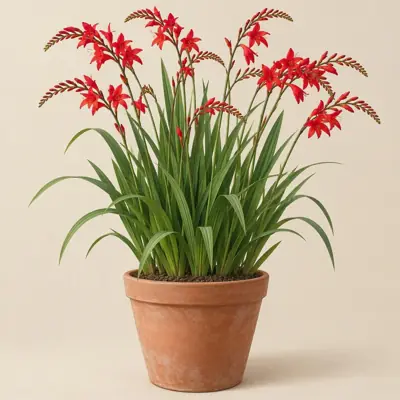
With few sources available, mature height is reported at about 90–90 cm. The leaves are reported to be narrow and sword-shaped, arising from the base, with prominent longitudinal ribs; they are shorter than the flowering stems. 'Lucifer' is reported to have bright red flowers, while Crocosmia flowers open sequentially upward along the inflorescence.
Light
It is reported to grow in full sun to partial shade, performing best in full sun; in hot climates, afternoon shade may prolong flowering.
Watering
During growth, it is reported to prefer evenly moist soil that does not dry out completely while retaining good drainage.
Temperature and dormancy
It is reported to tolerate brief light frost.
Growing medium and mounting
It is reported to prefer well-drained garden soil and not to tolerate poorly drained or overly wet soil.
Propagation
It can be propagated by division in early spring. Crocosmia × crocosmiiflora can also produce fertile seed that may be sown when mature, but seedlings do not reliably retain the parent's flower color.
Common problems
Spider mites are reported to cause damage, and a strong stream of water on the leaves may help remove and suppress them. Some Crocosmia species or cultivars spread by underground stems and may eventually become weedy and invade neighboring beds; Crocosmia × crocosmiiflora has records of naturalization or invasion in multiple regions. It is reported to be susceptible to cold damage at sufficiently low temperatures; in hot climates, afternoon shade may prolong flowering, and hot, dry winds are best avoided.
Identification
Crocosmia crocosmiiflora has underground corms and sword-shaped leaves; 'Lucifer' is distinguished by bright red flowers.
Sources
- GBIF Backbone: Crocosmia × crocosmiiflora (Lemoine) N.E.Br. — CC BY 4.0 · link
- Wikipedia (en): Crocosmia × crocosmiiflora — CC BY-SA 4.0 · link
- Wikipedia (en): Crocosmia crocosmiiflora — CC BY-SA 4.0 · link
- GBIF descriptions: Manual of the Alien Plants of Belgium; The checklist of alien seed plants of D.R. Congo, based on ev — per dataset · link
- TaiCOL 臺灣物種名錄: Crocosmia crocosmiiflora — CC BY 4.0 · link
- NC State Plant Toolbox: Crocosmia (genus-level) — copyright (facts only) · link