
dutch crocus (Crocus vernus)
Crocus vernus is a perennial terrestrial herb with a corm-like underground organ, although sources describe its habit differently.
Overview
Crocus vernus is a perennial terrestrial herb with a corm-like underground organ, although sources describe its habit differently.
Origin and habitat
Sources differ on its native range, describing it as European and principally associated with the Alps, the Balkans, and mountainous areas from southern to central Europe. It is reported from grassland habitats, including subalpine to alpine grasslands in central and southern Europe, and from naturalized settings in Britain such as cemeteries and roadside grasslands. It is reported to be associated with European mountain and subalpine-to-alpine environments and can produce leaves and flowers in spring where snow is present.
Characteristics
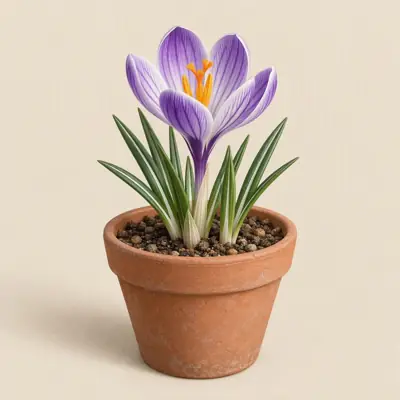
Sources differ on mature height, placing it at about 5–15 cm, while the few available sources report a mature spread of about 0–10 cm. The basal leaves are narrow and grass-like, with a conspicuous white longitudinal midline or midrib; their margins may roll downward, and they are usually not fully developed at flowering time. Sources differ in their descriptions of the flowers and flowering period: the flowers are upright and usually solitary and terminal, may be cup-shaped, range mainly from white to purple with possible purple stripes or dark markings, and have yellow anthers; flowering occurs mainly in spring, with individual records from snowy valleys extending into early August. The fruit is reported to be a capsule.
Light
Sources differ on light and positioning guidance, describing full sun and recommending a south- or west-facing position.
Watering
The growing medium should be well drained; genus-level information also indicates moderate moisture during the growing season and drought tolerance, while poorly drained heavy clay should be avoided.
Temperature and dormancy
Crocus vernus is reported to have RHS H6 hardiness and to be frost hardy.
Growing medium and mounting
It is reported to grow in chalk, clay, loam, or sand, provided drainage is good, and can grow in acidic, neutral, or alkaline soil.
Propagation
It is reported to be propagated in autumn by separating new corms formed around the parent corm, or by seed; seed propagation takes several years before flowering.
Common problems
It does not tolerate prolonged drought, so cultivation requires both good drainage and moisture during the growing period. The flowers are reported to respond sensitively to temperature changes and may close when larger clouds pass overhead; the plant can also produce leaves where snow is present.
Identification
Crocus vernus is reported to be a low-growing, spring-flowering corm plant with narrow basal leaves bearing a white midline and upright white-to-purple flowers that often have stripes or dark markings; large horticultural forms may have larger flowers than other commonly cultivated crocuses.
Photos


Sources
- Wikipedia (en): Crocus vernus — CC BY-SA 4.0 · link
- 維基百科:春番紅花 — CC BY-SA 4.0 · link
- Wikipedia (de): Frühlings-Krokus — CC BY-SA 4.0 · link
- Wikipedia (fr): Crocus vernus — CC BY-SA 4.0 · link
- Wikipedia (es): Crocus vernus — CC BY-SA 4.0 · link
- GBIF descriptions: Manual of the Alien Plants of Belgium; Database of Vascular Plants of Canada (VASCAN); DAISIE - Inve — per dataset · link
- Wikipedia (it): Crocus vernus — CC BY-SA 4.0 · link
- RHS Plants: Crocus vernus — © RHS, facts only · link
- USDA PLANTS Database: Crocus vernus — Public domain (US Government work) · link
- NC State Plant Toolbox: Crocus (genus-level) — copyright (facts only) · link