
Wendt's water trumpet (Cryptocoryne wendtii)
Cryptocoryne wendtii is a herbaceous, rosette-forming aquatic or wetland plant that grows mainly from rhizomes and roots in the substrate. It is reported to be perennial.
Overview
Cryptocoryne wendtii is a herbaceous, rosette-forming aquatic or wetland plant that grows mainly from rhizomes and roots in the substrate. It is reported to be perennial.
Origin and habitat
Cryptocoryne wendtii is native to Sri Lanka, with more detailed accounts placing it in western and central Sri Lanka. It is reported to inhabit streams, rivers, and seasonally flooded wetlands, with roots anchored in bottom sediments; monsoon-driven changes in water level can expose it to both emersed and submerged growth phases. In its native environment, it is reported to grow with emersed leaves along banks when water levels fall and to shift to submerged growth as water levels rise during the rainy season.
Characteristics
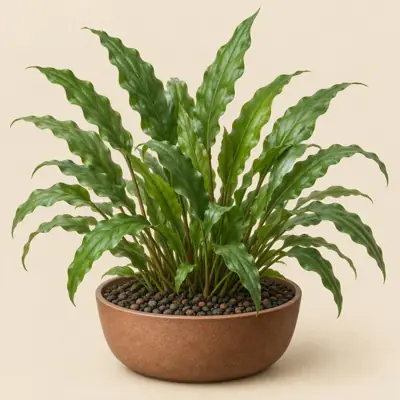
Sources differ, but the few available sources place mature height at about 10–20 cm. Growth is slow to moderate. Green, broadly lance-shaped leaves with slightly wavy or crinkled margins form rosette-like clumps from the base, and their appearance varies with environmental conditions. Mature plants can flower under highly humid emersed growing conditions.
Light
Cryptocoryne wendtii tolerates low light, and low to moderate light is the primary recommended range for 'Green', although it can tolerate higher light.
Watering
Cryptocoryne wendtii is suited to submerged aquarium cultivation with stable conditions; sudden environmental changes may cause Cryptocoryne melt.
Humidity and airflow
Cryptocoryne wendtii is generally reported to prefer high humidity.
Temperature and dormancy
The few available sources report a temperature range of about 22–28 °C.
Growing medium and mounting
Cryptocoryne wendtii is reported to grow well in aquarium substrate that its roots can penetrate and to prefer nutrient-rich aquatic plant soil; with inert substrates such as sand or gravel, root fertilizer can be supplied near the roots. It is rhizomatous.
Feeding
Cryptocoryne wendtii feeds heavily through its roots and can be supplied through nutrient-rich substrate or root fertilizer; added CO2 is not necessary to maintain growth but can promote growth and denser foliage.
Propagation
New plants can form on runners and be separated and replanted after rooting; propagation is also possible by dividing the rhizome or root portions with viable nodes, while seed propagation can occur in natural environments.
Common problems
Changes of environment, transplanting, or sudden shifts in water conditions can cause Cryptocoryne melt, in which older leaves rapidly deteriorate or dissolve; if the underground roots remain healthy and conditions stay stable, new leaves adapted to submerged conditions can subsequently grow. Cryptocoryne wendtii is sensitive to sudden or severe environmental changes, with leaf loss or melt particularly likely after movement following establishment or changes in water conditions.
Identification
The green form of Cryptocoryne wendtii forms dense rosette-like clumps with bright green leaves and slightly wavy margins; it can grow submerged or with emersed leaves in highly humid conditions.
Photos


Sources
- Wikipedia (en): Cryptocoryne wendtii — CC BY-SA 4.0 · link
- USDA PLANTS Database: Cryptocoryne wendtii — Public domain (US Government work) · link
- Cryptocoryne wendtii Species | Tropical Fish Hobbyist Magazine (www.tfhmagazine.com) — facts only (§12) · link
- Cryptocoryne Wendtii Green - Live Aquarium Plant — Buce Plant (buceplant.com) — facts only (§12) · link
- Cryptocoryne wendtii 'Green' for Blackwater Aquariums & Shrimp Tanks (bettabotanicals.com) — facts only (§12) · link
- Cryptocoryne wendtii Species | Tropical Fish Hobbyist Magazine — facts only (§12) · link
- Cryptocoryne Wendtii Green - Live Aquarium Plant — Buce Plant — facts only (§12) · link
- Cryptocoryne wendtii 'Green' for Blackwater Aquariums & Shrimp Tanks — facts only (§12) · link
- ADA PLANTS GALLERY #14 「クリプトコリネ・ウェンティ」 | AQUA DESIGN AMANO — facts only (§12) · link