
Never Never Plant (Ctenanthe setosa)
Ctenanthe setosa is a clumping herbaceous plant with a dense, bushy habit. Sources differ on its description as an evergreen perennial.
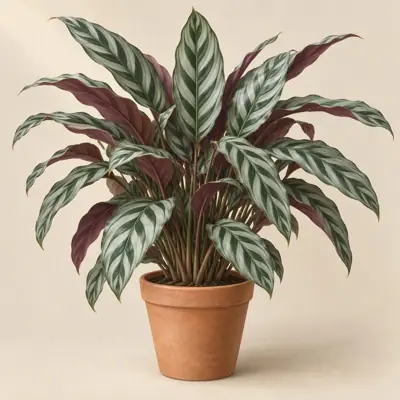
Overview
Ctenanthe setosa is a clumping herbaceous plant with a dense, bushy habit. Sources differ on its description as an evergreen perennial.
Origin and habitat
Sources differ on its native range: it is recorded from Brazil, with TaiCOL further describing it as native to southeastern Brazil. It is reported to occur in native forests in Brazil.
Characteristics
A source reports a mature height of about 100–150 cm and a mature spread of about 50–100 cm; sources are few. The ornamental leaves have dark- and light-green bands on the upper surface and purple to purplish-red undersides; within the genus, leaf shapes range from lance-shaped to inversely egg-shaped. Cultivated plants rarely flower; within the genus, the flowers are inconspicuous, white or yellow, tubular, and borne in short racemes. Flowering may occur intermittently through the year, although it is rare in cultivated plants.
Light
Grow in partial shade to bright, indirect light, avoiding strong direct light as the main growing light.
Watering
It is reported to need ample watering from spring through summer; in winter, keep the growing medium moist while ensuring good drainage.
Temperature and dormancy
A source reports a minimum temperature requirement, but the qualitative claim does not provide a renderable number. It is reported to have an RHS hardiness rating of H1B.
Growing medium and mounting
It is reported to grow in loam; containers can use a peat-free, loam-based growing medium that stays moist but drains well, with acidic, neutral, or alkaline conditions all suitable.
Feeding
It is reported to be fed with a general-purpose liquid fertilizer monthly from spring through summer.
Propagation
It can be divided in spring and is also commonly propagated vegetatively by division in cultivation. Seeds can also be sown as soon as possible after they ripen in spring; RHS also gives a sowing-temperature recommendation.
Common problems
It is reported to be susceptible to mealybugs and generally to have few disease problems. Reported environmental priorities include high humidity, a moist but well-drained growing medium, and avoidance of drafts. It is not frost tolerant and is best kept in a sheltered, draft-free location with stable temperatures.
Identification
Its main reported ornamental features are alternating dark- and light-green bands on the upper leaf surface and purple to purplish-red undersides.
Photos

