
Sowbread (Cyclamen hederifolium)
Cyclamen hederifolium is a perennial herbaceous plant with an underground tuber. It flowers and produces leaves in autumn; the leaves persist through winter, and the plant enters summer dormancy after late spring to early summer.
Overview
Cyclamen hederifolium is a perennial herbaceous plant with an underground tuber. It flowers and produces leaves in autumn; the leaves persist through winter, and the plant enters summer dormancy after late spring to early summer.
Origin and habitat
Sources differ on its native range: it is described as native to the Mediterranean region, mainly from southern France to western Turkey and including Corsica, Sardinia, Crete and Aegean and other Mediterranean islands, while some sources describe the range more broadly as southern Europe, Europe, Africa and temperate Asia. It occurs in woodland, scrub and rocky areas, often in shaded woodland, and some sources associate it with limestone environments; its distribution extends from sea level into higher elevations. It is reported to be adapted to a Mediterranean seasonal rhythm, growing in winter and becoming dormant in summer, and is also described as adaptable to an oceanic climate and relatively cold-hardy.
Characteristics
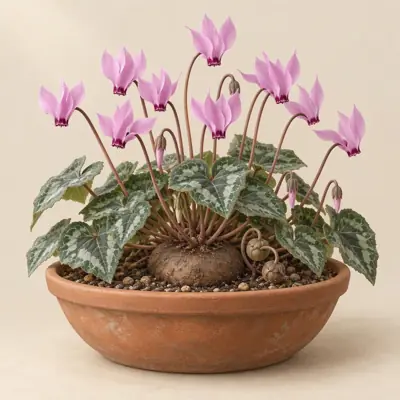
Sources differ on mature height, placing it at about 8–30 cm; mature spread is 10–50 cm. The leaves vary greatly in shape, from heart-shaped or arrow-shaped to ivy-like, angularly lobed or toothed, and usually bear silver-gray, silvery-white or gray-green markings; they generally emerge after the flowers and persist through winter. The flowers have reflexed petals, commonly pink to purple but also occurring in white forms, with a usually darker throat or a magenta V-shaped marking; some flowers are fragrant. Flowering occurs from late summer into autumn and may continue until the first frost in some areas; after flowering, the flower stalk coils from its tip, bringing the nearly spherical capsule close to the ground or tuber, and the fruit matures around early summer of the following year before releasing its seeds.
Light
Cyclamen hederifolium grows in partial sun to shade and is especially suited to bright shade beneath trees; some sources also indicate that it can grow in sun or shade where the soil is suitable.
Watering
Grow it in a well-drained medium, keeping it moderately moist during the growing season; it can also tolerate drier conditions and dry shade, and should be kept on the drier side during summer dormancy.
Temperature and dormancy
A single source reports cold tolerance to about -18 °C, with few sources supporting this figure. It is generally rated RHS H5.
Growing medium and mounting
It prefers well-drained, humus-rich soil and can adapt to chalk, clay, loam and sand; sources also record a broad soil-reaction tolerance and note that it commonly occurs on limestone substrates in its natural habitat.
Propagation
It can be propagated from seed, with fresh seed sown in a cold frame; sources also record propagation by division or by separating larger tubers in mid-spring.
Common problems
It tolerates dry summers and is relatively cold-hardy; The Ferns records substantial cold tolerance.
Identification
It is reported to have a flattened, rounded underground tuber with roots arising mainly from its upper surface and sides; flowers commonly appear before the ivy-like, silver-marked leaves, and the flower stalk coils conspicuously after flowering.
Photos


Sources
- Wikipedia (en): Cyclamen hederifolium — CC BY-SA 4.0 · link
- Wikipedia (de): Efeublättriges Alpenveilchen — CC BY-SA 4.0 · link
- Wikipedia (fr): Cyclamen hederifolium — CC BY-SA 4.0 · link
- Wikipedia (es): Cyclamen hederifolium — CC BY-SA 4.0 · link
- GBIF descriptions: Manual of the Alien Plants of Belgium; Database of Vascular Plants of Canada (VASCAN); DAISIE - Inve — per dataset · link
- NC State Plant Toolbox: Cyclamen hederifolium — copyright (facts only) · link
- Useful Tropical/Temperate Plants: Cyclamen hederifolium — CC BY-NC-SA 3.0 (facts only) · link
- RHS Plants: Cyclamen hederifolium — © RHS, facts only · link