
florist's cyclamen (Cyclamen persicum)
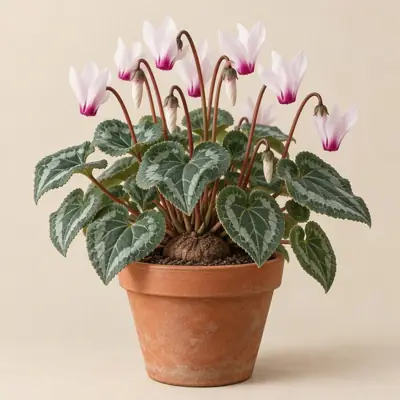
Cyclamen persicum is a perennial herb with an underground tuber, typically forming a clustered or mounded growth habit.
Overview
Cyclamen persicum is a perennial herb with an underground tuber, typically forming a clustered or mounded growth habit.
Origin and habitat
Sources differ on aspects of its native range; its core native range is in the eastern Mediterranean and western Asia, from Asia Minor to the Levant, including southern Turkey toward Israel and Jordan, and it is not native to Persia (Iran). It grows on rocky slopes, in scrub and woodland, with horticultural sources also describing pine woodland, oak scrub and rocky slopes. It is adapted to an eastern Mediterranean seasonal climate with hot, dry summers and cool, wetter winters, and it favors cool conditions during active growth.
Characteristics
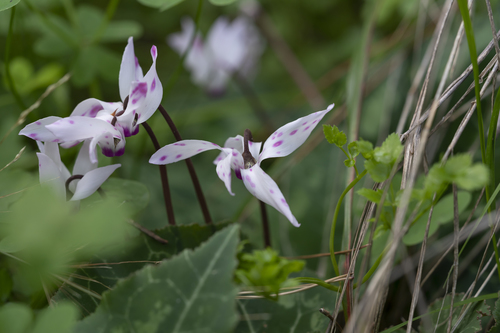
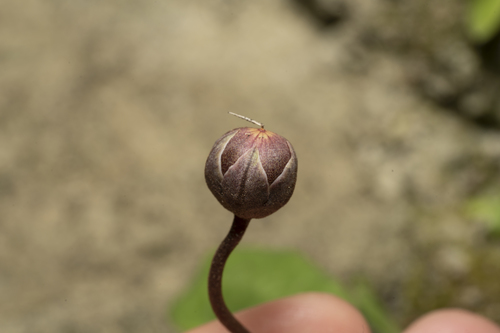
Sources differ on mature height, placing it at about 10–32 cm, while a single source reports a mature spread of about 10–50 cm. The fleshy, heart-shaped, long-stalked leaves are usually green to dark green, often with paler or silvery-gray markings; their undersides may be pale green or reddish, and the margins are often slightly thickened and toothed. Flowers are borne singly on long stalks and have strongly upswept petals; wild forms are mainly white to pale pink, often with dark pink, magenta or carmine markings at the base, while cultivated forms also occur in red, deep pink, magenta and lavender, and the species may have a sweet fragrance. Sources differ on flowering season: flowering is mainly from winter into spring, while var. autumnalis flowers in autumn, and under cultivation flowering may extend from autumn into the following spring; the fruit is reported to be a capsule carried toward the ground as the flower stalk bends downward after pollination, containing multiple brown seeds.
Light
Cyclamen persicum favors bright conditions and can accept full sun to partial sun; indoors or in a greenhouse, bright filtered light is suitable, and agricultural information indicates that it needs regular daily sunlight during flowering.
Watering
Maintain moderate moisture during growth and flowering while ensuring good drainage and avoiding excessive wetness; gradually reduce watering after flowering and keep conditions drier during dormancy.
Humidity and airflow
Cyclamen persicum is generally reported to prefer moderate humidity.
Temperature and dormancy
The ideal temperature range is 12–20 °C. Sources differ on the maximum temperature, with limited evidence placing it at about 30 °C.
Growing medium and mounting
Cyclamen persicum prefers humus-rich, well-drained soil that remains moderately moist; loam is suitable, and the soil may be acidic, neutral or alkaline.
Feeding
During active growth, a low-nitrogen liquid fertilizer may be applied regularly; during flowering, liquid flower fertilizer may help maintain flowering and flower color.
Propagation
Propagation is mainly by seed, with mature seed sown in cool, dark conditions; agricultural information from Taiwan also describes attempting propagation from the underground tuber, although this is prone to rotting under hot, humid conditions.
Common problems
High temperatures can trigger heat dormancy, hot and humid conditions can cause underground tubers used for propagation to rot, and an excessively wet growing medium does not meet its cultivation needs. Cyclamen persicum does not tolerate high temperatures and is sensitive to frost; sources also describe poor cold tolerance, and dormancy readily occurs during hot periods.
Identification
Cyclamen persicum is reported to have a perennial, round to slightly flattened underground hypocotyl tuber with a corky surface; roots arise mainly from below the tuber, while long-stalked, heart-shaped, patterned leaves emerge above it. The flowers hang downward while their petals are strongly swept upward; after pollination the flower stalk bends downward but does not coil as conspicuously as in many other Cyclamen species.
Photos


Sources
- Wikipedia (en): Cyclamen persicum — CC BY-SA 4.0 · link
- 維基百科:仙客来 — CC BY-SA 4.0 · link
- Wikipedia (ja): シクラメン — CC BY-SA 4.0 · link
- Wikipedia (de): Zimmer-Alpenveilchen — CC BY-SA 4.0 · link
- Wikipedia (fr): Cyclamen persicum — CC BY-SA 4.0 · link
- Wikipedia (es): Cyclamen persicum — CC BY-SA 4.0 · link
- GBIF descriptions: Lista de especies de plantas exóticas y trasplantadas de Colombia; Catálogo de Plantas y Líquenes de — per dataset · link
- NC State Plant Toolbox: Cyclamen persicum — copyright (facts only) · link
- 農業知識入口網 植物圖鑑: Cyclamen persicum — © MOA, facts only · link
- RHS Plants: Cyclamen persicum — © RHS, facts only · link