
Boat Orchids (Cymbidium hybrid)
Cymbidium is reported to be a perennial, evergreen, sympodial herbaceous orchid genus. Depending on the species, plants may be epiphytic, lithophytic, or terrestrial; a very small minority are leafless and saprophytic, while most have pseudobulbs.
Overview
Cymbidium is reported to be a perennial, evergreen, sympodial herbaceous orchid genus. Depending on the species, plants may be epiphytic, lithophytic, or terrestrial; a very small minority are leafless and saprophytic, while most have pseudobulbs.
Origin and habitat
Cymbidium is reported to be native from tropical and subtropical Asia to Australia, including northern India, China, Japan, Malaysia, the Philippines, and Borneo. Depending on the species, plants may grow on trees, rocks, or the ground, and some high-elevation species are reported to be lithophytic or epiphytic. Horticultural sources also report native habitats in cool, bright, high-elevation parts of Asia, with different groups occurring across climates ranging from warm conditions to cooler highlands. Large-flowered and miniature groups are reported to differ somewhat in their temperature requirements.
Characteristics
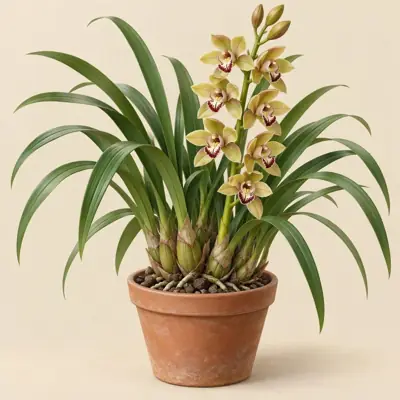
Sources differ on mature height, reporting about 30–80 cm. A single source reports a mature spread of about 30.48–91.44 cm, so sources are few. The evergreen leaves are reported to be typically narrow, linear to strap-shaped, and arching; pseudobulbs or new shoots bear leaves in opposing rows, and individual leaves may persist for years. Flowers are reported to occur on unbranched stalks usually arising from the base of a pseudobulb; the sepals and ordinary petals are similar in form, while the lip is conspicuously specialized and lobed. Reported flower colors include white, pink, orange, yellow, green, brown, and multicolored forms, with flower size and abundance varying greatly among species and horticultural groups. Horticultural forms are generally reported to flower from winter into spring, while some tropical miniature forms may flower in summer. After pollination, plants are reported to form hairless capsules containing many pale seeds.
Light
Cymbidium is generally reported to need a very bright environment and high light; greenhouse plants may receive high light with moderate midday shading, while home-grown plants may be placed by bright south-, east-, or west-facing windows. Some shading may be provided outdoors during intense summer sunlight. A specialist source reports a light range of about 32250–64500, so sources are few.
Watering
During spring and summer growth, Cymbidium is generally reported to need ample water and to be kept evenly moist in a well-drained medium. Watering is generally reduced gradually after the pseudobulbs finish growing in late summer, with lower moisture maintained in winter, while water shortage should be avoided as flower buds begin to elongate.
Humidity and airflow
Specialist sources report a preferred humidity of about 40–60 %, though sources are few. Cymbidium generally prefers moderate humidity and needs good airflow.
Temperature and dormancy
Cymbidium is generally described as cool-growing and as tolerating brief light frost. A specialist source reports that outdoor cultivation throughout the year may be possible in mild climates within its stated hardiness conditions.
Growing medium and mounting
For container culture, specialist guidance generally recommends a well-drained orchid medium that also retains moisture, such as medium-grade bark with peat and perlite or mixtures containing bark and pumice; ordinary soil-like materials are not recommended as the main growing medium. Cymbidium is generally described as semi-terrestrial, with fleshy roots and a preference for bark.
Feeding
Specialist guidance generally recommends regular feeding during the growing season, with fertilizer formulations adjusted as growth and flower-stalk development progress and feeding withheld in winter. Another reported approach uses solid organic or slow-release fertilizer from spring into early summer, with liquid feeding continuing later in the growing period.
Propagation
Cymbidium is generally propagated mainly by division, often in conjunction with spring repotting. Specialist guidance recommends retaining a new growth point together with several pseudobulbs in each division, while old pseudobulbs may also be potted separately after producing new growth.
Common problems
Cymbidium is reported to be susceptible to aphids, mites, and scale insects. Waterlogging or excessive watering may cause root rot, insufficient water may cause brown spots, and excessively strong direct sunlight may scorch leaves. Excessive temperatures or insufficient differences between daytime and nighttime temperatures may promote leaf growth without ready flowering. Sources differ on weather sensitivity: standard forms are reported to depend more strongly on cool nights and day-night temperature differences for flowering, while some miniature forms tolerate heat better; brief light frost may be tolerated, although specialist guidance advises protecting plants from frost.
Identification
Most species are reported to have pseudobulbs and narrow evergreen leaves, with flower stalks usually arising from the base of the pseudobulbs. The lip differs conspicuously from the other petals and sepals and has a distinctly lobed form.