
Cold-growing Cymbidium (Cymbidium kanran)
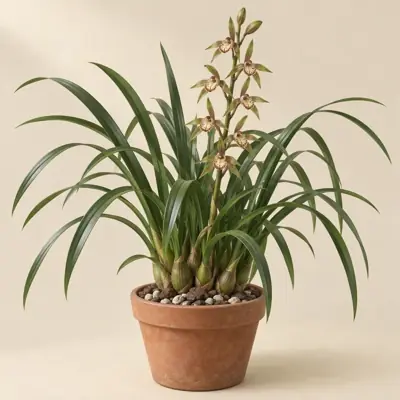
Cymbidium kanran is reported to be a large, perennial orchid with spherical pseudobulbs, no creeping stem, and a clumping habit. It is primarily described as growing on rock, though another account describes it as terrestrial.
Overview
Cymbidium kanran is reported to be a large, perennial orchid with spherical pseudobulbs, no creeping stem, and a clumping habit. It is primarily described as growing on rock, though another account describes it as terrestrial.
Origin and habitat
Cymbidium kanran is native to south-central and southeastern China, Hainan, Tibet, Japan, Korea, the Ryukyu Islands, Taiwan, and Vietnam. Sources differ on its habitat, describing rocky areas and erosion-formed rocky channels as well as deeply shaded sites in forest or open forest. It is associated with a cool climate and is described as suited to cool conditions.
Characteristics
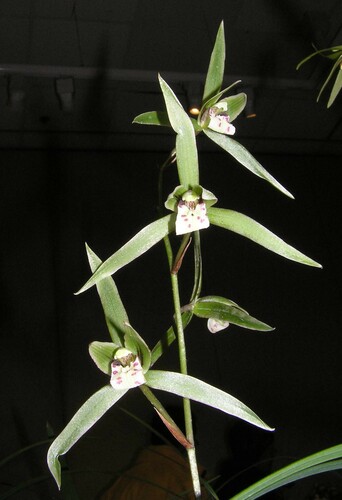
The leaves are generally linear to linear-elliptic, tapering at the tip, arching, dark green and glossy, with margins near the tip often finely serrated. The inflorescence is reported to arise from the base of a pseudobulb, to be slender and stiff, and to extend above the leaves; its flowers have narrow pointed petals, may be green with red stripes or flushing or may have reddish or yellow forms, and have a smaller white to pale-yellow lip usually marked with small red spots and a fragrance. It is reported to flower from late autumn into winter and to grow slowly, with flowering from seed potentially taking many years. Its mature height is reported by few sources to be about 100 cm.
Light
Sources differ: species-specific records describe Cymbidium kanran in deep shade in the wild, while general Cymbidium cultivation information recommends bright, high light while avoiding scorching, and these should not be treated as equivalent requirements. It is also generally classified as requiring high light.
Watering
General Cymbidium guidance is reported to call for ample water and an evenly moist medium during spring and summer growth, particularly avoiding complete drying in summer, followed by reduced watering later in growth and slightly moist conditions in winter. The stated drying preference is generally to keep evenly moist.
Humidity and airflow
Few sources indicate a preferred humidity of about 40–60 %, and it is generally described as preferring moderate humidity. It generally needs good airflow.
Temperature and dormancy
Cymbidium kanran is classified as cool-growing, with an ideal temperature range of 10–23.8 °C. It is generally reported to tolerate brief light frost, although general Cymbidium guidance for mild climates only considers year-round outdoor growing where conditions permit.
Growing medium and mounting
For potted Cymbidium, a moisture-retentive but well-drained medium is generally recommended, such as medium-grade bark with peat and perlite; another horticultural source recommends a mixture including bark and pumice. Cymbidium kanran is reported to be lithophytic, with fleshy roots and a preference for bark.
Feeding
General Cymbidium guidance recommends feeding during the growing season; one source recommends higher-nitrogen fertilizer in spring, a more balanced fertilizer from summer into early autumn, a flowering formula after flower spikes form, and no fertilizer in winter, while another recommends solid fertilizer from spring through summer and liquid fertilizer later into the growing period.
Propagation
Cymbidium kanran is generally propagated by division, which may be carried out alongside spring repotting.
Common problems
Reported pests include aphids, scale insects, and spider mites, with aphids potentially more common while flower buds are developing. Reported disease concerns include viral disease and, where airflow or humidity management is poor, gray mold affecting flowers. General guidance reports that persistently waterlogged medium can cause root rot, insufficient water can cause brown spots, and excessive heat may prevent flowering in some Cymbidium. It prefers cool conditions; although general Cymbidium information indicates brief light frost may be tolerated, the cited guidance does not recommend managing it that way and advises bringing plants indoors when conditions become sufficiently cold.
Identification
Cymbidium kanran is reported to be distinguished by narrowly ovoid pseudobulbs, slender arching glossy dark-green leaves, upright inflorescences arising from the base, and strongly fragrant flowers.
Photos


Sources
- Wikipedia (en): Cymbidium kanran — CC BY-SA 4.0 · link
- 維基百科:寒兰 — CC BY-SA 4.0 · link
- Wikipedia (ja): カンラン — CC BY-SA 4.0 · link
- Wikipedia (es): Cymbidium kanran — CC BY-SA 4.0 · link
- TaiCOL 臺灣物種名錄: Cymbidium kanran — CC BY 4.0 · link
- Internet Orchid Species Photo Encyclopedia: Cymbidium kanran — © Jay Pfahl / IOSPE contributors, facts only · link
- AOS culture sheet: Cymbidium (genus-level) — © American Orchid Society, facts only · link
- NHK みんなの趣味の園芸 植物図鑑: Cymbidium (genus-level) — © NHK出版, facts only · link
- NC State Plant Toolbox: Cymbidium (genus-level) — copyright (facts only) · link