
Cymbidium sinense (Cymbidium sinense)
Cymbidium sinense is an evergreen, perennial, clump-forming herbaceous orchid that can grow terrestrially and has pseudobulbs.
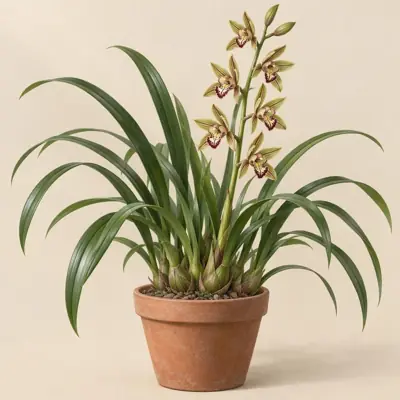
Overview
Cymbidium sinense is an evergreen, perennial, clump-forming herbaceous orchid that can grow terrestrially and has pseudobulbs.
Origin and habitat
Sources differ on its native range, which is described as including Taiwan, mainland China south of the Yangtze River, Vietnam, and Myanmar. It is reported from lowland forest in humus-rich environments, including moist rock crevices or soil beside steep waterways where mist and spray provide moisture. It is reported to suit warm, moist, partially shaded conditions.
Characteristics
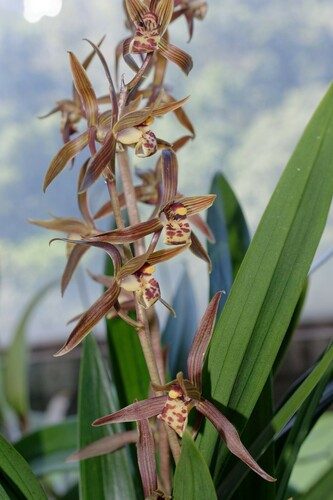
Few-source information places mature height and spread at about 50–100 cm. The glossy leaves are narrow and elongated, ranging from sword-shaped to long-lanceolate, and grow in clusters. The upright raceme bears sweetly fragrant flowers that are usually pale purplish-brown, with narrow-lanceolate sepals and petals and a drooping, recurved lip. Flowering is reported from autumn to spring, while the fruit is a capsule that becomes dark brown when mature and contains numerous small seeds.
Light
Sources differ on light conditions, describing partial or dappled shade with good light while avoiding strong direct sunlight. A specialist source reports high light, at about 32250–64500, although sources are few.
Watering
Provide ample water during active growth while maintaining good drainage; water thoroughly as the medium approaches dryness and reduce watering in winter. It is generally described as needing to be kept evenly moist.
Humidity and airflow
Few-source information places suitable humidity at about 40–60 %, and it is generally described as preferring high humidity. It is generally reported to need good airflow.
Temperature and dormancy
A single source reports a minimum temperature of about 10 °C, so sources are few. It is reported as warm-growing and is classified as H1C. It is frost tender; keep above freezing.
Growing medium and mounting
Use a well-drained orchid medium, which may include horticultural grit, sphagnum moss, or coconut fiber; another account describes a preference for a humus-rich, slightly acidic, well-drained substrate. It is generally described as terrestrial with fleshy roots, and one source reports a preference for bark.
Feeding
It is reported to benefit from regular orchid fertilizer during the growing season.
Propagation
Division is the main propagation method; tissue culture is also possible, while seed propagation requires a controlled laboratory environment.
Common problems
It may be affected by aphids, greenhouse red spider mites, scale insects, and mealybugs. Disease is generally uncommon, but viral diseases such as Cymbidium Mosaic Virus can occur; disinfecting cutting tools can help reduce the risk of viral transmission. Poorly drained medium may be unsuitable for growth; strong direct light should be avoided and watering reduced in winter. Sources differ regarding weather sensitivity, but describe avoiding strong direct sunlight and using a more sheltered position; Taipei Collectible Botanical Garden records it as having weak cold tolerance.
Identification
Cymbidium sinense has oval, stout, swollen pseudobulbs, narrow elongated leaves, and upright racemes, with fragrant flowers held above the foliage.
Photos


Sources
- TaiCOL 臺灣物種名錄: Cymbidium sinense — CC BY 4.0 · link
- RHS Plants: Cymbidium sinense — © RHS, facts only · link
- Internet Orchid Species Photo Encyclopedia: Cymbidium sinense — © Jay Pfahl / IOSPE contributors, facts only · link
- AOS culture sheet: Cymbidium (genus-level) — © American Orchid Society, facts only · link
- 臺北典藏植物園 植物資料庫: Cymbidium sinense — © 臺北典藏植物園, facts only · link
- NHK みんなの趣味の園芸 植物図鑑: Cymbidium (genus-level) — © NHK出版, facts only · link
- NC State Plant Toolbox: Cymbidium (genus-level) — copyright (facts only) · link