
African Tree Grape (Cyphostemma bainesii)
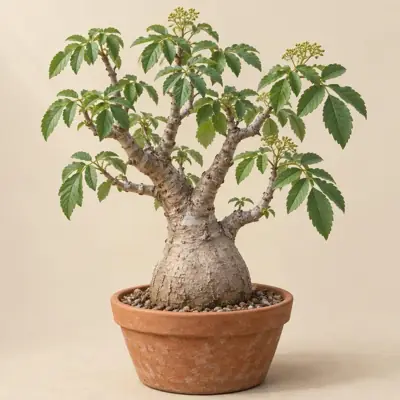
Cyphostemma bainesii is a deciduous caudiciform succulent shrub to small tree with an enlarged, bottle-shaped trunk. It is perennial and loses its leaves in winter.
Overview
Cyphostemma bainesii is a deciduous caudiciform succulent shrub to small tree with an enlarged, bottle-shaped trunk. It is perennial and loses its leaves in winter.
Origin and habitat
Sources differ on its native range: it is reported from Namibia and South Africa, while some sources regard it as endemic to Namibia and dispute whether South Africa is part of its native distribution.
Characteristics
Sources differ on mature height, placing it at about 100–180 cm. It is reported to grow quite slowly. The large, deciduous leaves are yellow-green to gray-green and may have red, wavy margins and relatively dense hairs. It has grape-like orange to red fruit, a thickened trunk (pachycaul), and can develop into a shrub or small tree with a tuberous trunk.
Light
Sources differ somewhat on light: it prefers abundant sunlight, while afternoon shade or partial sun may reduce leaf scorch in hot areas.
Watering
It is drought tolerant; during summer growth it can receive more generous watering, but overwatering should be avoided, while winter conditions should be dry or given very little water to reduce the risk of rot. Withhold water while leafless.
Temperature and dormancy
Sources differ on the lower temperature limit, reporting about -3 °C, while the few available sources report an upper temperature of about 40 °C. Sources differ on the reported hardiness zone; it tolerates brief light frost and has a cold minimum of -3 °C. It drops its leaves and goes dormant, and dormancy is reported to be triggered by cold. It is reported to have high heat tolerance.
Growing medium and mounting
It needs a fast-draining mix; containers can use a fertile, well-drained cactus-type medium, while well-drained loam or sandy soil can be used in the ground.
Feeding
It is reported that fertilizer can be applied during summer growth.
Propagation
It can be propagated by sowing or cuttings; sowing may involve aged and scarified material placed in moist sterile medium in winter under warm, humid conditions, and germination is often slow and uneven. Cuttings can be grown in coarse river sand with careful watering.
Common problems
Young plants especially should be protected from frost, and freezing should still be avoided for mature plants despite their capacity for brief cold exposure. Strong sun in hot areas may scorch the leaves, and afternoon shade may help.
Identification
It has a thick, sometimes bottle-shaped tuberous trunk with smooth, papery, yellow-brown to pale bark that peels in rings to reveal a gray-green inner layer. It resembles Cyphostemma juttae but is described as shorter and more robust.
Photos


Sources
- Wikipedia (en): Cyphostemma bainesii — CC BY-SA 4.0 · link
- LLIFLE Encyclopedia of living forms: Cyphostemma bainesii — CC BY-SA · link
- Desert-Tropicals: Cyphostemma bainesii — © Philippe Faucon (desert-tropicals.com), facts only · link
- The Succulent Plant Page: Cyphostemma (genus-level) — © R.J. Hodgkiss, facts only · link
- Top Tropicals catalog: Cyphostemma bainesii — © Top Tropicals LLC (facts only) · link
- PUKUBOOK: Cyphostemma bainesii — CC BY-NC (facts only) · link