
Butter Tree (Cyphostemma currorii)
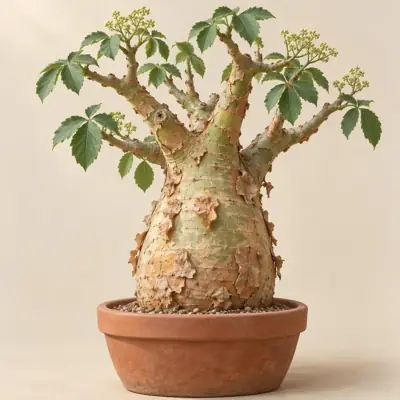
Cyphostemma currorii is a perennial, deciduous succulent-stemmed shrub to small tree with a swollen, water-storing thickened trunk.
Overview
Cyphostemma currorii is a perennial, deciduous succulent-stemmed shrub to small tree with a swollen, water-storing thickened trunk.
Origin and habitat
Sources differ on its native range: it is from southern Africa, with more specific accounts concentrated from southern Angola to northwestern and central-western Namibia, while specimen and observation records are also concentrated mainly in Namibia and Angola. It inhabits hot, arid rocky places, including rocky outcrops, dry slopes and mountainous terrain, and is often found on steep slopes. It is reported from a hot, dry climate with dry winters in its native environment and is reported to adapt to Mediterranean-type climates and withstand high temperatures.
Characteristics
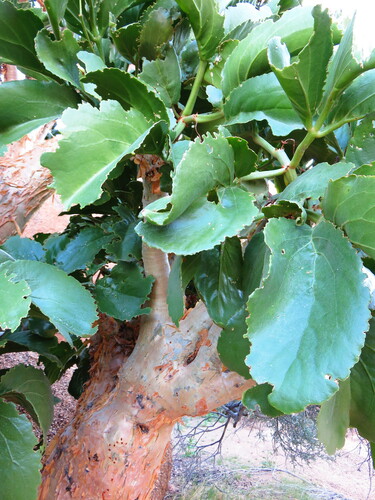
Sources differ on mature height, giving a range of about 100–800 cm. It is reported to grow quite slowly and has a thickened trunk (pachycaul); its large, fleshy, bright green leaves are trifoliate with long petioles and irregularly toothed margins, and the plant remains leafless for a substantial part of the year. Sources differ in describing the very small cream-white to yellow-green flowers, which are borne in inflorescences on long flower stalks; flowering has been recorded in its native habitat, with only a few individuals flowering at the recorded times. It is reported to produce clusters of grape-like berries that turn red when ripe, with fruit ripening over an extended period; mature plants are generally described as shrubs to small trees of substantial height.
Light
It is reported to prefer abundant sunlight throughout the year, while some afternoon shade in hot regions can reduce the risk of leaf scorch.
Watering
It is reported to be drought tolerant; during summer growth it can receive ample water without overwatering, while in winter it should be kept dry to reduce the risk of rot. It is generally recommended to withhold water while leafless.
Temperature and dormancy
Sources differ on the lower temperature limit, placing it at about -3 °C; another limited-source account likewise reports a cold minimum of about -3 °C. A limited source reports an upper temperature of about 40 °C and high heat tolerance. It tolerates brief light frost. It is reported to drop its leaves and go dormant, with dormancy triggered by cold.
Growing medium and mounting
It is reported to do well in a fertile, fast-draining cactus or succulent medium in containers, while loam or sandy soil can be used in the ground, with good drainage being important. It needs a fast-draining mix.
Feeding
It is reported that fertilizer can be applied during summer growth.
Propagation
It is reported to be propagated from seeds or cuttings; seeds require treatment, aging and scarification, and germination is slow and uneven. Cuttings are reported to be usable with coarse river sand as the medium, with careful watering after rooting.
Common problems
Overwatering is reported to potentially kill the plant, while an overly wet medium in winter increases the risk of rot. It dislikes wet winter conditions; mature plants can briefly tolerate low temperatures, but freezing should be avoided, and young plants are especially sensitive. It can tolerate hot conditions, but intense afternoon sun may cause leaf scorch.
Identification
Cyphostemma currorii has a conspicuously swollen, water-storing trunk that ranges from barrel-like to tuber-like, with yellow to orange bark that peels in papery sheets to reveal green bark beneath; its overall form can resemble a small baobab.
Photos


Sources
- GBIF Backbone: Cyphostemma currorii (Hook.fil.) Desc. — CC BY 4.0 · link
- Wikipedia (en): Cyphostemma currorii — CC BY-SA 4.0 · link
- Wikipedia (es): Cyphostemma currorii — CC BY-SA 4.0 · link
- LLIFLE Encyclopedia of living forms: Cyphostemma currorii — CC BY-SA · link
- The Succulent Plant Page: Cyphostemma (genus-level) — © R.J. Hodgkiss, facts only · link