
Japanese netvein hollyfern (Cyrtomium falcatum)
Cyrtomium falcatum is a perennial terrestrial fern that grows in evergreen clumps, although sources differ on whether its above-ground fronds may die back in colder regions.
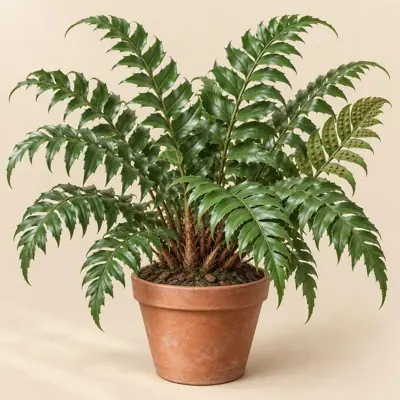
Overview
Cyrtomium falcatum is a perennial terrestrial fern that grows in evergreen clumps, although sources differ on whether its above-ground fronds may die back in colder regions.
Origin and habitat
Cyrtomium falcatum is native to East Asia, with sources explicitly including eastern China, Japan, Korea, and Vietnam; sources differ, while a Taiwan species checklist treats Taiwanese populations as native. It occurs on coastal rock faces and in crevices, rocky slopes, around streams or waterfalls, in forests, and on artificial stone structures such as walls; sources differ in their accounts, though several describe rocky or well-drained substrates. Its native climate ranges from temperate to subtropical East Asia and extends into tropical areas of Vietnam, and it can grow in temperate climates with mild winters.
Characteristics
Sources differ and are few on mature height, placing it at about 30–60 cm, while mature spread is 60–90 cm. It is reported to grow quickly and has an erect rhizome. Sources differ in describing the leathery, usually glossy, once-pinnate fronds: the lateral pinnae are generally ovate-lanceolate to sickle-shaped, their margins may be entire, wavy, shallowly toothed, or irregularly coarsely toothed, and the veins may form a network. It is reported to have no flowers; as a fern, it reproduces by spores.
Light
Sources differ: several horticultural sources support partial to full shade with low indirect light, while some also report cultivation in full sun or bright light. It is reported to tolerate deep shade.
Watering
Sources differ on watering: most horticultural sources recommend keeping the growing medium moderately moist but well drained, avoiding standing water and reducing watering in winter, while the Taipei Collectible Botanical Garden recommends watering after the medium dries and avoiding persistently wet roots. Keep evenly moist.
Temperature and dormancy
Sources are few and differ on minimum temperature, with a reported value of about -15 °C. Sources differ on the cultivation hardiness range, giving several different USDA zone ranges. Cyrtomium falcatum is frost hardy and hardy.
Growing medium and mounting
A well-drained, well-aerated medium with moderate moisture retention is suitable; humus-rich soil, sandy loam, or potting mix may be used, and the species adapts to a broad range of soil textures.
Feeding
Mature plants generally do not require frequent feeding; slow-release fertilizer may be used infrequently, while the Taipei Collectible Botanical Garden recommends regular long-lasting complete fertilizer for young plants and no fertilizer for mature plants.
Propagation
It can be propagated from spores or by rhizome division, with rhizome division commonly used in cultivation. It can reproduce apogamously, and its spores are readily dispersed over long distances by wind; a spore-maturation period is also documented. It is reported that the rhizome can be divided and newly separated divisions placed in a well-aerated medium to root.
Common problems
Sources differ on pests: scale insects, mealybugs, spider mites, and Florida fern caterpillar may occur, with mealybugs and spider mites more likely to attack plants weakened by drought, while RHS describes the species as generally having no significant pest problems. Sources differ on disease occurrence, with fungal leaf spots and root rot reported while RHS describes it as generally having no significant diseases. Standing water or persistently wet roots run counter to some cultivation recommendations, and cold conditions may cause frost damage to the fronds. It has some cold tolerance, but in cold regions it may become deciduous or suffer frost damage; some sources also report tolerance of heat and drought.
Identification
Its sickle-shaped, thick, glossy pinnae resemble holly leaves, while the undersides of the fronds bear round sori covered by indusia.
Photos


Sources
- GBIF Backbone: Cyrtomium falcatum (L.fil.) C.Presl — CC BY 4.0 · link
- Wikipedia (en): Cyrtomium falcatum — CC BY-SA 4.0 · link
- 維基百科:全缘贯众 — CC BY-SA 4.0 · link
- Wikipedia (fr): Cyrtomium falcatum — CC BY-SA 4.0 · link
- NC State Plant Toolbox: Cyrtomium falcatum — copyright (facts only) · link
- Wikipedia (nl): IJzervaren — CC BY-SA 4.0 · link
- TaiCOL 臺灣物種名錄: Cyrtomium falcatum — CC BY 4.0 · link
- Useful Tropical/Temperate Plants: Cyrtomium falcatum — CC BY-NC-SA 3.0 (facts only) · link
- RHS Plants: Cyrtomium falcatum — © RHS, facts only · link
- USDA PLANTS Database: Cyrtomium falcatum — Public domain (US Government work) · link
- 臺北典藏植物園 植物資料庫: Cyrtomium falcatum — © 臺北典藏植物園, facts only · link
- Hardy Fern Foundation: Cyrtomium (genus-level) — © The Hardy Fern Foundation, facts only · link
- Top Tropicals catalog: Cyrtomium falcatum — © Top Tropicals LLC (facts only) · link
- Cyrtomium falcatum: Complete guide to care, characteristics, and propagation of (en.jardineriaon.com) — facts only (§12) · link