
Unscented Dendrobium (Dendrobium anosmum)
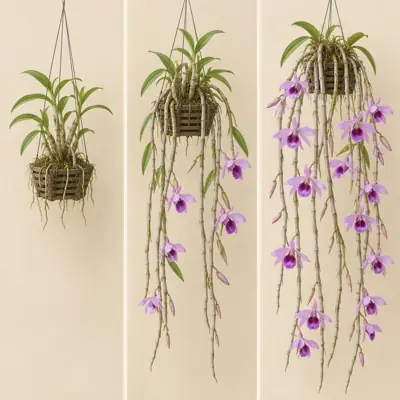
Dendrobium anosmum is a large epiphytic orchid with slender, jointed stems that arch or hang downward, giving mature plants a pendulous habit. It is a deciduous perennial herbaceous orchid with distinct growth and dormancy periods.
Overview
Dendrobium anosmum is a large epiphytic orchid with slender, jointed stems that arch or hang downward, giving mature plants a pendulous habit. It is a deciduous perennial herbaceous orchid with distinct growth and dormancy periods.
Origin and habitat
Dendrobium anosmum occurs in Southeast Asia and neighboring regions, including Sri Lanka, Indochina, Malaysia, Laos, Vietnam, Hong Kong, the Philippines, Indonesia, and the Papua and New Guinea region. It is an epiphyte of forest environments such as stream valleys and corridor forests in lowland primary forest. It is adapted to warm to intermediate conditions, with a wetter growing period followed by a drier dormant phase in autumn and winter.
Characteristics
Sources differ on mature height, placing it at about 50–100 cm, while a single source reports a mature spread of about 50–100 cm. The deciduous leaves are glossy bright green, arranged along the nodes, oblong to elliptic, and pointed at the tip; mature stems may be leafless around flowering. The large flowers are usually pale to deep pink or purple, with near-white to white forms also occurring; they emerge from nodes on mature leafless stems, have a densely hairy lip, and are typically conspicuously fragrant, with some sources describing a strong raspberry-like scent. Sources differ somewhat on flowering season: flowering is mainly in spring, with some accounts extending it into late spring or summer.
Light
Provide bright, filtered light throughout the year; sources describe tolerance of stronger light or partial shade, while unsuitable intense direct light can scorch the leaves. Light levels of 16000–32000 are supported by specialist sources, while a single source generally characterizes the plant as requiring high light.
Watering
After new shoots begin growing, water more frequently and thoroughly during active growth while maintaining good drainage; reduce watering markedly as dormancy begins in autumn and resume it when new growth starts in spring. A single source generally recommends letting it dry between waterings.
Humidity and airflow
Humidity of 40–70 % is supported, and the plant prefers high humidity. A specialist source reports that it needs good airflow.
Temperature and dormancy
A single source reports an ideal range of about 16–30 °C, so sources are few for this range. Published hardiness classifications indicate limited cold hardiness. A single source generally describes it as frost tender and advises keeping it above freezing. A specialist source generally classifies it as intermediate to warm.
Growing medium and mounting
Use a well-drained epiphytic orchid medium based on medium-grade bark with horticultural grit, sustainably sourced moss, or coir; it is also suitable for growing attached to cork bark or wood. Dendrobium anosmum is epiphytic and is suited to being mounted.
Feeding
Feed regularly during the growing period, increasing feeding during vigorous new growth and reducing or stopping it as autumn dormancy begins.
Propagation
A single source reports that seed propagation requires a controlled laboratory environment, while mature plants can be divided after filling their container. The same source reports that older stems may produce keikis, which can be removed after developing sufficient new roots and planted in moss.
Common problems
A single source reports possible problems with scale insects, aphids, mealybugs, and spider mites, while generally reporting few disease problems. Overwatering during dormancy or insufficient water during active growth can cause serious growth problems; excessive light may cause yellowing or scorching, and poor drainage does not meet its epiphytic cultivation needs. It is sensitive to frost and freezing conditions, and its growing position should be sheltered.
Identification
Dendrobium anosmum is distinguished by long, many-jointed pendulous stems, seasonal deciduousness, and large fragrant pink to purple flowers that emerge from nodes of mature leafless stems and have densely hairy lips.
Photos


Sources
- Wikipedia (en): Dendrobium anosmum — CC BY-SA 4.0 · link
- Wikipedia (es): Dendrobium anosmum — CC BY-SA 4.0 · link
- Wikipedia (it): Dendrobium anosmum — CC BY-SA 4.0 · link
- Wikipedia (pt): Dendrobium anosmum — CC BY-SA 4.0 · link
- RHS Plants: Dendrobium anosmum — © RHS, facts only · link
- Internet Orchid Species Photo Encyclopedia: Dendrobium anosmum — © Jay Pfahl / IOSPE contributors, facts only · link
- AOS culture sheet: Dendrobium (genus-level) — © American Orchid Society, facts only · link
- NC State Plant Toolbox: Dendrobium (genus-level) — copyright (facts only) · link
- Top Tropicals catalog: Dendrobium anosmum — © Top Tropicals LLC (facts only) · link