
Seokgok (Dendrobium moniliforme)
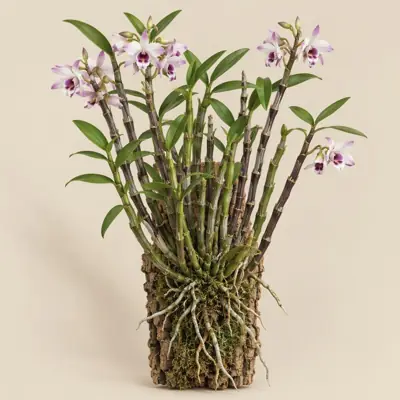
Dendrobium moniliforme is a small epiphytic orchid that can also grow on rocks, with clustered, slender pseudobulbs resembling stems and bearing many nodes. It is perennial, with deciduous leaves and older pseudobulbs that can remain alive for years, although sources differ in their descriptions.
Overview
Dendrobium moniliforme is a small epiphytic orchid that can also grow on rocks, with clustered, slender pseudobulbs resembling stems and bearing many nodes. It is perennial, with deciduous leaves and older pseudobulbs that can remain alive for years, although sources differ in their descriptions.
Origin and habitat
Sources differ on its native range, describing it across East Asia, the Himalayas, and northern Indochina, including Japan, the Korean Peninsula, China, the Himalayan region, Nepal, northeastern India, Myanmar, and Vietnam. It grows on tree trunks or large trees in forests and also occurs on rocks in settings such as forests and stream-valley cliffs. In Nepal, its evergreen broadleaf forest habitat is reported to have pronounced monsoonal rainfall, with a subtropical to warm-temperate climate at higher elevations, and winters that are warm to mild with generally little frost.
Characteristics
Sources differ, with limited evidence suggesting a mature height of about 5–25 cm. The leaves are narrow and elongated to narrowly lanceolate, somewhat thick, relatively firm, and glossy; they grow at the nodes of annual pseudobulbs and can fall after maturing. The fragrant flowers are mainly white to pink or tinged reddish purple, emerging from nodes of older leafless pseudobulbs, with short inflorescences capable of bearing several flowers. Sources differ on flowering season: cultivation information from Japan describes a principal flowering period in late spring to early summer, while plants from different origins or under different cultivation conditions may flower from winter into summer.
Light
Provide stronger sunlight in spring and autumn, changing to bright partial shade in summer, and avoid intense sunlight that can scorch the leaves. A light level of 16000–32000 is supported for cultivation. Overall, it is suited to medium light.
Watering
Water thoroughly after the medium dries; increase water during spring growth, avoid excessive moisture while flower buds form in autumn, and reduce watering during winter dormancy. Do not leave it waterlogged for long periods or allow sphagnum moss to dry so completely that it becomes difficult to rewet; overall, keep slightly dry.
Humidity and airflow
Limited specialist sources suggest about 40–70 % humidity, although evidence is sparse. It is reported to prefer high humidity and to need good airflow.
Temperature and dormancy
It is generally described as cool to intermediate and is reported to tolerate brief light frost.
Growing medium and mounting
Dendrobium moniliforme is epiphytic and requires a highly aerated, fast-draining medium; suitable materials include sphagnum moss, hard Kanuma soil, pumice, chopped sphagnum moss, orchid potting mix, or bark medium, with good drainage and aeration in the container. Sphagnum moss is reported to be a preferred medium.
Feeding
Liquid fertilizer can be applied from bud emergence until new growth matures and again during the autumn maturation period, with feeding reduced in winter.
Propagation
It can be propagated by division or keikis, and old pseudobulbs can be laid horizontally to encourage axillary buds; seed propagation is also possible but is not common in home cultivation.
Common problems
It is reported to be subject to feeding damage from aphids, slugs, noctuid larvae, and grasshoppers. Reported diseases include viral disease and black spot; uneven leaf coloration or mosaic patterns may be associated with viral disease, and brown, scratch-like symptoms on new growth are also noted as a concern. Excess water is reported to cause rot, while excessive dryness can cause desiccation; too much moisture while flower buds form in autumn may promote their conversion to vegetative buds, and strong summer light may cause leaf scorch. It is reported to require protection from overly strong summer sunlight and excessive heat, while strong winter winds should be avoided and plants grown outdoors on trees or rocks in cold areas need additional cold protection.
Identification
The pseudobulbs are slender, hard, and many-noded, often growing in clusters; stems may change from green to blackish purple or purplish green, and older stems can still produce fragrant flowers from nodes near the tip after losing their leaves.
Photos


Sources
- GBIF Backbone: Dendrobium moniliforme (L.) Sw. — CC BY 4.0 · link
- Wikipedia (en): Dendrobium moniliforme — CC BY-SA 4.0 · link
- Wikipedia (ja): セッコク — CC BY-SA 4.0 · link
- Useful Tropical/Temperate Plants: Dendrobium moniliforme — CC BY-NC-SA 3.0 (facts only) · link
- Internet Orchid Species Photo Encyclopedia: Dendrobium moniliforme — © Jay Pfahl / IOSPE contributors, facts only · link
- AOS culture sheet: Dendrobium (genus-level) — © American Orchid Society, facts only · link
- NHK みんなの趣味の園芸 植物図鑑: Dendrobium moniliforme — © NHK出版, facts only · link
- NC State Plant Toolbox: Dendrobium (genus-level) — copyright (facts only) · link