
Noble Dendrobium (Dendrobium nobile)
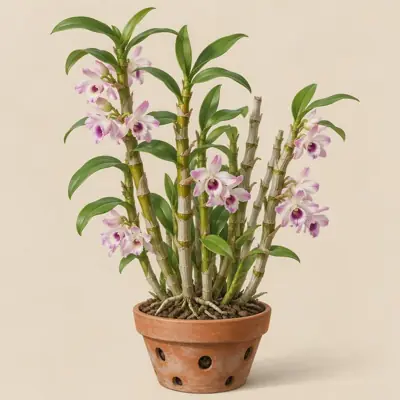
Dendrobium nobile is a perennial, clumping, upright sympodial orchid that forms fleshy, stem-like pseudobulbs. Sources differ in describing it as growing on trees or rocks, with some also reporting terrestrial growth.
Overview
Dendrobium nobile is a perennial, clumping, upright sympodial orchid that forms fleshy, stem-like pseudobulbs. Sources differ in describing it as growing on trees or rocks, with some also reporting terrestrial growth.
Origin and habitat
It is native from southern to southeastern Asia, including southern China and the Himalayan regions of India, Nepal, Bhutan and Bangladesh, as well as Myanmar, Thailand, Laos and Vietnam. It grows in moist lowland or montane forests, where it may occur on tree trunks, valley rocks and mossy limestone. Its natural habitats range from lowland to montane environments and are described as spanning cool to warm conditions, with strongly seasonal growth and a drier, cooler winter dormancy.
Characteristics
Sources differ on mature height, reporting about 10–60 cm, while the few available sources report a mature spread of about 10–50 cm. The leathery leaves are arranged along the stems and range in shape from strap-like and oblong to ovate; sources differ in describing the foliage as evergreen, semi-evergreen or deciduous. The fragrant flowers are thick and waxy, borne on short racemes, and vary widely in color, including white, pink and purple, with orange, yellow, green and multicolored forms among cultivated selections. Flowering occurs mainly from winter through spring.
Light
Dendrobium nobile does best in bright to partly shaded conditions with ample filtered light, corresponding to medium light, while overly strong direct midday light can scorch the leaves.
Watering
Water thoroughly during active growth, using a well-drained medium and allowing it to dry slightly between waterings; after the stems mature, reduce watering markedly through autumn and winter and resume normal watering when new shoots begin growing.
Humidity and airflow
It is generally reported to prefer high humidity, with the few available sources indicating about 40–70 %. It needs good airflow.
Temperature and dormancy
The few available sources suggest an approximate temperature range of 5–30 °C. It is generally described as intermediate to warm and frost tender; keep above freezing. Sources differ on its reported hardiness-zone classification.
Growing medium and mounting
Dendrobium nobile is epiphytic and is grown in a well-drained, well-aerated orchid medium, including sphagnum in an unglazed pot or fine to medium orchid bark in a plastic pot; loam with acidic to neutral conditions and good drainage is also listed. A bark and sphagnum mix is a suitable media preference.
Feeding
Feed during the growing season and stop before dormancy; specialist sources describe feeding through active growth and withholding fertilizer later as dormancy approaches.
Propagation
Dendrobium nobile can be propagated from seed, stem cuttings with dormant buds, division, or keikis; for home cultivation, division of larger plants or removing and planting rooted keikis after they form small pseudobulbs is particularly recommended.
Common problems
Possible pests include aphids, greenhouse red spider mites, mealybugs and slugs, with new shoots and flower buds particularly susceptible to slug feeding. Sources report that disease problems are generally uncommon, although black spots may sometimes appear on leaves from summer into autumn and usually have little effect on growth. Insufficient light can cause elongated growth, while excessive light can cause yellowing or leaf scorch, and persistently wet roots are unfavorable for growth; failure to reduce water and fertilizer and provide cooler conditions as mature stems enter autumn and winter may affect flowering. It has weak cold tolerance and is sensitive to frost and freezing; in cold regions, protected indoor or greenhouse conditions are recommended in winter.
Identification
Dendrobium nobile can be recognized by its clumping, nearly upright, fleshy, jointed, stem-like pseudobulbs; fragrant flowers form at nodes along older leafy or leafless stems from winter into spring.
Photos


Sources
- Wikipedia (en): Dendrobium nobile — CC BY-SA 4.0 · link
- 維基百科:石斛 — CC BY-SA 4.0 · link
- Wikipedia (ja): デンドロビウム・ノビル — CC BY-SA 4.0 · link
- Wikipedia (fr): Dendrobium nobile — CC BY-SA 4.0 · link
- Useful Tropical/Temperate Plants: Dendrobium nobile — CC BY-NC-SA 3.0 (facts only) · link
- RHS Plants: Dendrobium nobile — © RHS, facts only · link
- Internet Orchid Species Photo Encyclopedia: Dendrobium nobile — © Jay Pfahl / IOSPE contributors, facts only · link
- NHK みんなの趣味の園芸 植物図鑑: Dendrobium nobile — © NHK出版, facts only · link
- AOS culture sheet: Dendrobium (genus-level) — © American Orchid Society, facts only · link
- NC State Plant Toolbox: Dendrobium (genus-level) — copyright (facts only) · link
- Top Tropicals catalog: Dendrobium nobile — © Top Tropicals LLC (facts only) · link
- DendrobiumCulturebySueBottom.pdf (staugorchidsociety.org) — facts only (§12) · link
- Dendrobium Species Culture (orchidculture.com) — facts only (§12) · link