
Soft Tree-fern (Dicksonia antarctica)
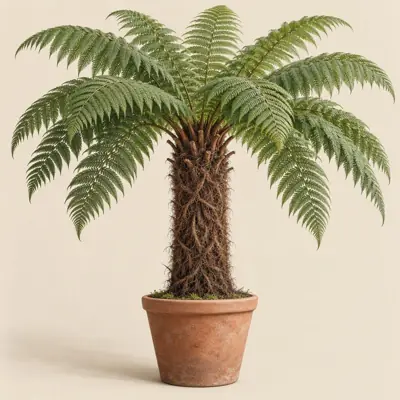
Dicksonia antarctica is a perennial tree fern, typically evergreen but potentially deciduous in colder areas, with an upright, trunk-like rhizome topped by a large crown of fronds.
Overview
Dicksonia antarctica is a perennial tree fern, typically evergreen but potentially deciduous in colder areas, with an upright, trunk-like rhizome topped by a large crown of fronds.
Origin and habitat
Sources differ on its native range, describing it as occurring from eastern to southeastern Australia, including southeastern Queensland, New South Wales, Victoria and Tasmania. Sources differ in their habitat accounts, which include high-rainfall forest, rainforest and moist sclerophyll forest, often on sheltered, moist slopes, in gullies and near streams, in moist, shaded conditions. It prefers a high-rainfall, moist, sheltered forest climate and can tolerate some cold, but not severe frost or drought.
Characteristics
Sources differ on mature size, with the few reported ranges being about 450–1500 cm in height and about 250–800 cm in spread. Growth is slow. Sources differ in descriptions of the large, dark-green fronds: they form a funnel-shaped or rosette-like crown at the top of the trunk, are divided into pinnate segments, may be glossy or relatively rough, and have long brown hairs at the base of the stalks. The rhizome is erect.
Light
A sheltered position from partial shade to full shade is preferred, although the plant can tolerate more sun when water is plentiful. It tolerates shade.
Watering
Keep the soil evenly moist but well drained, avoiding complete drying of the roots; supplemental water is needed during hot, dry summers.
Humidity and airflow
It has a high humidity need and is reported to prefer high humidity. It is generally reported to need little air movement.
Temperature and dormancy
Sources differ on the minimum temperature, with the few available reports indicating about -5 °C. It is described as frost hardy and half hardy. It is suited to relatively mild hardiness zones, with winter protection needed in colder areas.
Growing medium and mounting
Moist but well-drained, humus-rich loam or sandy soil is suitable; sources differ on soil reaction, with some recommending acidic to neutral conditions and others recording growth in alkaline soil.
Propagation
Propagation is mainly by sowing mature spores; some sources also describe using young plants produced at the rhizome base or, under particular circumstances, rerooting the upper part of the trunk. Spores are produced only after a long period of growth and form in sori on the underside of fertile fronds. A single source reports propagation from young plants at the rhizome base and by cutting off lateral buds, keeping them moist and allowing the upper portion to reroot.
Common problems
Outdoor cultivation is reported to have few pest problems, and disease problems are also generally reported to be uncommon. Dry roots or drought cause marked growth stress, while cold areas require winter protection. It does not tolerate severe frost, and strong winds can damage the large fronds; it can tolerate snow and brief light frost, but needs winter protection in cold areas.
Identification
Dicksonia antarctica has a stout, upright, trunk-like rhizome covered with fibrous roots, brown hairs and remnants of old frond stalks, with huge pinnate fronds clustered at the top. Sori occur on the underside of the fronds, usually near the margins of the pinnate segments.
Photos

Sources
- Wikipedia (en): Dicksonia antarctica — CC BY-SA 4.0 · link
- 維基百科:軟樹蕨 — CC BY-SA 4.0 · link
- Wikipedia (de): Australischer Taschenfarn — CC BY-SA 4.0 · link
- Wikipedia (fr): Dicksonia antarctica — CC BY-SA 4.0 · link
- Wikipedia (es): Balantium antarcticum — CC BY-SA 4.0 · link
- GBIF descriptions: DAISIE - Inventory of alien invasive species in Europe — per dataset · link
- Wikipedia (it): Dicksonia antarctica — CC BY-SA 4.0 · link
- Wikipedia (nl): Tasmaanse boomvaren — CC BY-SA 4.0 · link
- Wikipedia (pt): Dicksonia antarctica — CC BY-SA 4.0 · link
- Useful Tropical/Temperate Plants: Dicksonia antarctica — CC BY-NC-SA 3.0 (facts only) · link
- RHS Plants: Dicksonia antarctica — © RHS, facts only · link
- Hardy Fern Foundation: Dicksonia antarctica — © The Hardy Fern Foundation, facts only · link
- Top Tropicals catalog: Dicksonia antarctica — © Top Tropicals LLC (facts only) · link