
Venus flytrap (Dionaea muscipula)
Dionaea muscipula is a low-growing, rosette-forming perennial carnivorous herb.
Overview
Dionaea muscipula is a low-growing, rosette-forming perennial carnivorous herb.
Origin and habitat
Dionaea muscipula is native to a limited area of the eastern United States, especially coastal North Carolina and northeastern South Carolina. Its native habitats are wet, nutrient-poor, acidic wetlands, including wet pine flats, wet pine savannas, swamps, and Sphagnum peatlands. It is reported to be native to temperate to subtropical wetland environments and to have a winter dormancy cycle.
Characteristics
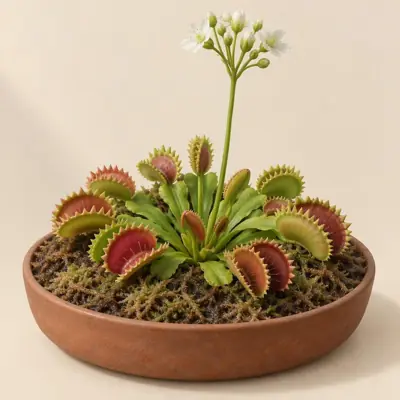
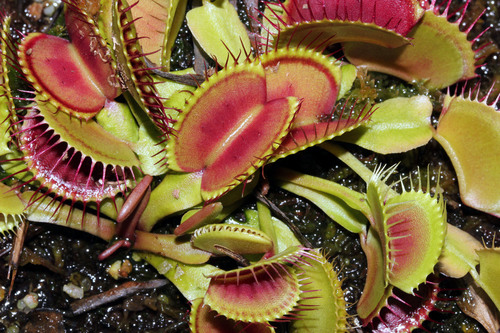
Mature plants reach 3.5–10 cm in height; sources differ on spread, with the limited information suggesting about 10–15 cm. Growth is reported to be slow. Sources differ in their descriptions of the traps: the leaves form a rosette with flattened petioles and hinged traps of paired lobes at their tips; the inner surfaces may be red, orange, or purple, with tooth-like or bristle-like margins and sensory hairs. Small white flowers are borne in clusters on stalks above the leaves, typically with petals and sepals; flowering occurs from early to midsummer, and after pollination the ovary enlarges and later matures into a round black fruit containing many black seeds.
Light
Dionaea muscipula grows in full sun to partial sun and should receive ample light in cultivation, with some shade or protection from the strongest midsummer sunlight when appropriate.
Watering
Sources differ in their watering descriptions, but the growing medium should remain moist and not dry out completely; rainwater or distilled water can be used, while treated chlorinated water or hard water may harm the plant, and water should not be withheld completely during winter dormancy. It is generally reported to require pure water only (rain, RO or distilled). Tray (bottom) watering is compatible with the plant, with a target of keeping it wet.
Temperature and dormancy
Sources differ on the minimum temperature. A source reports a defined hardiness range and notes that cultivation is possible in colder zones with suitable winter protection. Dionaea muscipula has cold winter dormancy.
Growing medium and mounting
Use an acidic, moisture-retentive but aerated medium, such as long-fiber Sphagnum or peat combined with coarse vermiculite or coarse sand; its native habitats also include acidic wetland soils low in minerals. Sand with peat is also reported as a substrate type.
Feeding
It is generally reported that fertilizer should not be applied. It is also reported to grow without supplementary feeding of insects.
Propagation
Dionaea muscipula is reported to be propagated from seed or by division.
Common problems
Aphids and mealybugs are reported as possible pests, while disease problems are generally reported to be uncommon. Drying of the medium is a risk, and hard water or treated chlorinated water may harm the plant; repeatedly triggering traps without purpose can consume energy and weaken leaves or the whole plant, while prey that is too large can cause trapping leaves to rot and wither. The plant is sensitive to drying and may be given some shade under intense midsummer light; it has limited cold tolerance, and winter cultivation should accommodate dormancy while avoiding severe frost.
Identification
Dionaea muscipula has traps at the leaf tips that can close rapidly when prey stimulates sensory hairs, and its prey includes insects, spiders, and other arthropods. It is the only species in the genus Dionaea.
Photos



Sources
- Wikipedia (en): Venus flytrap — CC BY-SA 4.0 · link
- 維基百科:捕蠅草 — CC BY-SA 4.0 · link
- Wikipedia (ja): ハエトリグサ — CC BY-SA 4.0 · link
- Wikipedia (de): Venusfliegenfalle — CC BY-SA 4.0 · link
- Wikipedia (fr): Dionée attrape-mouche — CC BY-SA 4.0 · link
- Wikipedia (es): Dionaea muscipula — CC BY-SA 4.0 · link
- GBIF descriptions: Guide to the Vascular Flora of the Savannas and Flatwoods of Shaken Creek Preserve and Vicinity (Pen — per dataset · link
- NC State Plant Toolbox: Dionaea muscipula — copyright (facts only) · link
- RHS Plants: Dionaea muscipula — © RHS, facts only · link
- USDA PLANTS Database: Dionaea muscipula — Public domain (US Government work) · link
- Tom's Carnivores: Dionaea (genus-level) — © Tom's Carnivores, facts only · link
- NHK みんなの趣味の園芸 植物図鑑: Dionaea muscipula — © NHK出版, facts only · link