
Giant Dioon (Dioon spinulosum)
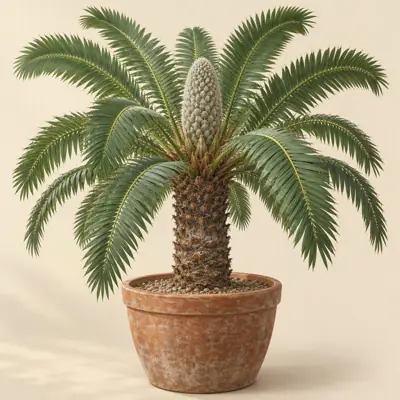
Dioon spinulosum is an evergreen, palm-like woody cycad, typically with an upright, unbranched trunk topped by a crown of large leaves. It is a perennial evergreen and is dioecious.
Overview
Dioon spinulosum is an evergreen, palm-like woody cycad, typically with an upright, unbranched trunk topped by a crown of large leaves. It is a perennial evergreen and is dioecious.
Origin and habitat
Sources differ in their accounts of its native range in southern Mexico, including Veracruz and Oaxaca. Sources differ in describing its habitat, which includes low-elevation tropical evergreen rainforest on limestone hills, cliffs, rock crevices, and rocky slopes; it is often found beneath the forest canopy, while some large individuals extend above it. It is reported to occur in a tropical climate with high annual rainfall concentrated mainly in summer, with hot, humid, rainy summers and warm, generally drier winters.
Characteristics
Sources differ on mature height, giving a range of about 300–1600 cm. Sources differ in describing its growth as slow to very slow. Mature plants have numerous large pinnate leaves with many leaflets; the leaves may arch or remain relatively upright, with spiny margins and visible parallel veins. It does not reproduce with flowers but forms male and female cones, with each dioecious plant producing only male or only female cones; sources differ in their descriptions of the very large female seed cones, which are densely covered with short hairs.
Light
Dioon spinulosum takes full sun and can also grow in bright partial sun or lower light; horticultural sources recommend conditions ranging from full sun and bright light to partial sun or light shade.
Watering
Water regularly to moderately where drainage is good, watering after the surface soil dries and avoiding prolonged wetness in winter; the plant can tolerate brief dry periods.
Humidity and airflow
Dioon spinulosum is reported to prefer high humidity.
Temperature and dormancy
Sources differ on the plant's hardiness-zone range. It is reported to tolerate brief light frost.
Growing medium and mounting
It prefers well-drained, neutral to alkaline soil and can grow in calcareous and nutrient-poor soils; prolonged waterlogging is unsuitable. It needs a fast-draining mix.
Feeding
In cultivation, a balanced fertilizer can be applied regularly, although Dioon spinulosum can also adapt to nutrient-poor soil.
Propagation
It can be propagated from seed, and botanical-garden sources also report propagation from basal offsets. Because it is dioecious, both a female and a male plant are needed to produce seed oneself.
Common problems
Fungal diseases are reported as a cultivation concern, and overly wet growing medium in winter may cause root rot. Slow growth can be a challenge, and poor drainage or excessive winter moisture may lead to root rot; wild plants whose tops are cut off generally do not readily resprout from the remaining rhizome. Sources differ on cold sensitivity: the plant has some tolerance of brief cold, but stronger frost or lower temperatures can damage the leaves, while some horticultural sources describe it as frost-sensitive and advise avoiding freezing conditions.
Identification
Dioon spinulosum is an especially large cycad with a thick upright stem, a large leaf crown, spiny leaf margins, and exceptionally large female seed cones.
Photos


Sources
- Wikipedia (en): Dioon spinulosum — CC BY-SA 4.0 · link
- Wikipedia (ja): ディオオン・スピヌロスム — CC BY-SA 4.0 · link
- Wikipedia (es): Dioon spinulosum — CC BY-SA 4.0 · link
- Useful Tropical/Temperate Plants: Dioon spinulosum — CC BY-NC-SA 3.0 (facts only) · link
- PACSOA wiki: Dioon spinulosum — © Palm & Cycad Societies of Australia (PACSOA) and credited contributors, facts only · link
- Top Tropicals catalog: Dioon spinulosum — © Top Tropicals LLC (facts only) · link
- Dioon spinulosum (desert-tropicals.com) — facts only (§12) · link
- Dioon spinulosum – Friends of Belfast Botanic Gardens (fobbg.co.uk) — facts only (§12) · link
- The Opposite of Freezing: Plants Have Upper Limits Too | GardenRiots — facts only (§12) · link
- Giant Dioon – Port St. Lucie Botanical Gardens — facts only (§12) · link
- Dioon spinulosum – Friends of Belfast Botanic Gardens — facts only (§12) · link