
Elephant's Foot Yam (Dioscorea elephantipes)
Dioscorea elephantipes is a deciduous, twining climber with a large caudex. It is perennial, growing mainly from autumn through spring and usually becoming leafless and dormant during the hot, dry season.
Overview
Dioscorea elephantipes is a deciduous, twining climber with a large caudex. It is perennial, growing mainly from autumn through spring and usually becoming leafless and dormant during the hot, dry season.
Origin and habitat
Dioscorea elephantipes is native mainly to the dry Cape regions of South Africa, including parts of the Northern Cape, Western Cape, and Eastern Cape; some sources also record it in Namibia. Its habitat consists of rocky or gravelly slopes in dry inland areas, often on quartz or shale soils and in sheltered scrub. Its climate has seasonal rainfall and hot, dry summers; it usually grows during the cooler winter and spring and is dormant during the hot, dry season.
Characteristics
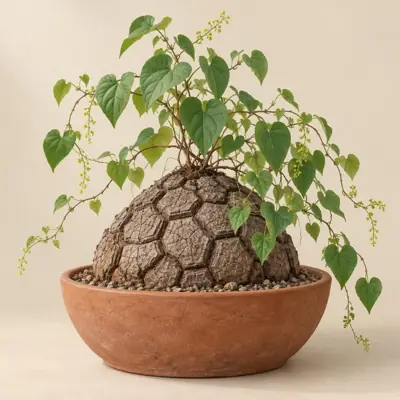
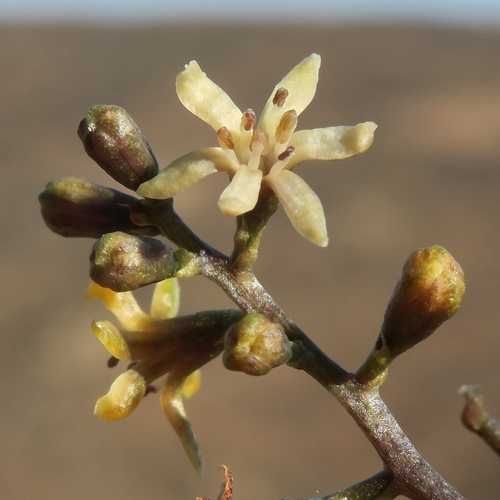
Sources differ on mature height, placing it at about 50–100 cm, while mature spread is 50–100 cm. The caudex grows slowly, while vines can elongate quickly during the growing season; the leaves are heart-shaped to nearly round, green to blue-green, and are shed before dormancy. The small, inconspicuous flowers are yellow-green to yellow, with male and female flowers borne on separate plants; sources differ on the flowering season in its native range, placing it around late autumn to winter in the Southern Hemisphere. The fruit is reported to be a capsule, and the plant has a tuber; one specialist source generally describes a large tuber and long seasonal vines.
Light
Sources differ: cultivation is recorded from bright conditions to full sun, but prolonged direct exposure of the caudex to intense heat and sun is best avoided, while the vines can receive stronger light.
Watering
Sources differ on watering details, but watering is mainly adjusted according to whether green new growth is present: during active growth, water regularly and moderately with rapid drainage, then greatly reduce water once dormancy begins and the vines and leaves die back. While in leaf, keep evenly moist; water sparingly while leafless.
Temperature and dormancy
Sources differ on the lower temperature limit, placing it at about -4 °C, while the few evidence available reports an upper limit of about 40 °C. Sources differ on the hardiness classification; it is also reported to be frost tender and should be kept above freezing. It drops its leaves and goes dormant, with dormancy triggered by heat, and it has high heat tolerance. Its cold minimum is -4 °C.
Growing medium and mounting
Dioscorea elephantipes needs a very fast-draining mix, which may be coarse, sandy, or gravelly; loam and sand are also listed as suitable, with acidic, neutral, or alkaline conditions.
Feeding
One source reports using a balanced liquid fertilizer during the growing period.
Propagation
Sources consistently support propagation by seed, while they differ on cuttings: one source records softwood cuttings when new growth emerges in spring, whereas others describe cuttings as difficult or consider seed the only propagation method.
Common problems
The plant is reported to be susceptible to aphids and froghopper-type pests and generally to have few disease problems. Natural dieback of vines and leaves during dormancy can make the plant appear dead, and sustained heavy watering should be avoided while it is dormant. Sources differ on weather sensitivity: the tuber is sensitive to prolonged direct exposure to intense heat and sun, and some horticultural sources also regard the plant as frost sensitive.
Identification
Its most distinctive feature is the large, partly exposed, woody-looking swollen stem; with age, the surface develops thick, hard, deeply fissured polygonal corky plates resembling a tortoise shell or an elephant's foot.
Photos


Sources
- Wikipedia (en): Dioscorea elephantipes — CC BY-SA 4.0 · link
- 維基百科:龜甲龍 — CC BY-SA 4.0 · link
- Wikipedia (ja): キッコウリュウ — CC BY-SA 4.0 · link
- Wikipedia (fr): Dioscorea elephantipes — CC BY-SA 4.0 · link
- LLIFLE Encyclopedia of living forms: Dioscorea elephantipes — CC BY-SA · link
- RHS Plants: Dioscorea elephantipes — © RHS, facts only · link
- Desert-Tropicals: Dioscorea elephantipes — © Philippe Faucon (desert-tropicals.com), facts only · link
- The Succulent Plant Page: Dioscorea (genus-level) — © R.J. Hodgkiss, facts only · link
- Top Tropicals catalog: Dioscorea elephantipes — © Top Tropicals LLC (facts only) · link
- Dioscorea elephantipes (Elephant's Foot) - Wave Hill (www.wavehill.org) — facts only (§12) · link
- Elephant’s Foot For Sale – Logee's Plants (www.logees.com) — facts only (§12) · link
- Schildkrötenpflanze ∗ Der große Ratgeber von A bis Z (www.gartenjournal.net) — facts only (§12) · link
- Dioscorea elephantipes caudex plant with tortoise-like tuber (www.araflora.com) — facts only (§12) · link
- Dioscorea Care Guide - Highland Moss (highlandmoss.com) — facts only (§12) · link