
Mexican yam (Dioscorea mexicana)
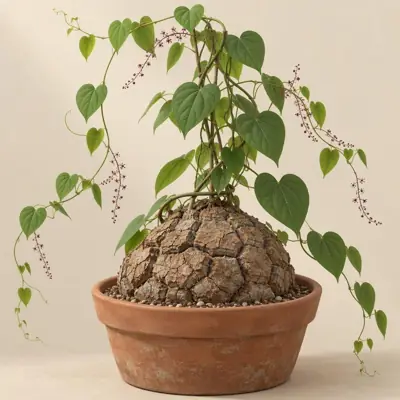
Dioscorea mexicana is a twining vine with a large caudex, which may be partly to fully exposed above the ground, and it produces vigorous vines during the growing season. It is a perennial tuberous plant with seasonally growing vines that usually die back in winter as the plant enters dormancy.
Overview
Dioscorea mexicana is a twining vine with a large caudex, which may be partly to fully exposed above the ground, and it produces vigorous vines during the growing season. It is a perennial tuberous plant with seasonally growing vines that usually die back in winter as the plant enters dormancy.
Origin and habitat
Sources differ on its distribution: it is described as extending from Mexico south through Central America to Panama, while Colombia is also recorded by a source. Sources differ on its habitat, describing secondary forest and, in another account, semi-arid areas. The reported habitat range spans semi-arid environments to secondary forest in Central America.
Characteristics
Mature dimensions are reported as 600–900 cm in height and 50–90 cm in spread, with vigorous, rapid vine growth during the growing season. The leaves are reported to be alternate, ovate to nearly round or heart-shaped, with prominent main veins and no stipules; Dioscorea mexicana has a tuber, and the tuber and vines can become large. Sources differ in their descriptions of the small, inconspicuous purple to reddish-purple flowers and their male and female floral structures; flowering occurs in August. The fruit is reported to be an elongated to elliptical capsule, pale to dark brown, with elongated to nearly round, marginally winged seeds.
Light
Dioscorea mexicana is reported to grow in bright conditions to partial shade.
Watering
It is reported to prefer a well-drained medium kept slightly moist, with water gradually increased when roots begin growing after dormancy, and it can tolerate extended dry periods. While in leaf, it is generally kept slightly dry.
Temperature and dormancy
The few available source records indicate a cold minimum of about 0 °C. It is reported to be frost tender and should be kept above freezing. It drops its leaves and goes dormant, while the dormancy trigger is not known.
Growing medium and mounting
A well-drained growing medium is recommended, with another source describing well-drained, humus-rich sandy soil. It is generally reported to need a very fast-draining mix.
Propagation
Propagation is reported to be by seed, with sowings kept warm and given indirect light.
Common problems
A cultivation source for the genus Dioscorea reports no notable pests observed, but this was not a formal pest survey specifically of Dioscorea mexicana. In containers, raising the caudex for display so that its sides cannot root normally is reported to cause the plant to gradually dry out. It can tolerate extended dry periods, and its thick woody outer covering is described as helping retain water and cope with drought.
Identification
Dioscorea mexicana is distinguished by a large hemispherical to dome-shaped tuber with a thick, woody gray-brown to brown exterior, regularly polygonal plates that become raised with age, and deep fissures between the plates, giving an appearance likened to a tortoise shell or elephant foot.
Photos


Sources
- Wikipedia (en): Dioscorea mexicana — CC BY-SA 4.0 · link
- Wikipedia (fr): Dioscorea mexicana — CC BY-SA 4.0 · link
- Wikipedia (es): Dioscorea mexicana — CC BY-SA 4.0 · link
- GBIF descriptions: Catálogo de Plantas y Líquenes de Colombia — per dataset · link
- LLIFLE Encyclopedia of living forms: Dioscorea mexicana — CC BY-SA · link
- The Succulent Plant Page: Dioscorea (genus-level) — © R.J. Hodgkiss, facts only · link
- PUKUBOOK: Dioscorea mexicana — CC BY-NC (facts only) · link
- Testudinaria (discorea) mexicana | Giromagi cactus and succulents for sale | Buy (www.giromagi.com) — facts only (§12) · link