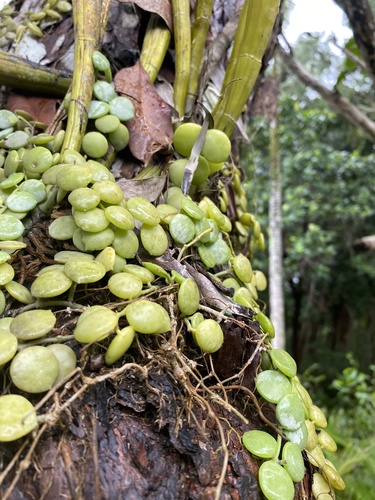
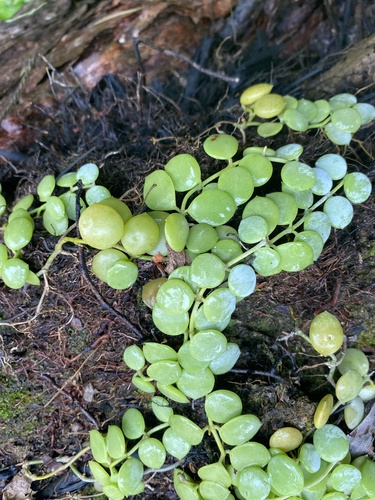
button orchid (Dischidia nummularia)
Dischidia nummularia is an epiphytic perennial herbaceous vine that can grow attached to tree trunks, bark, or rocks; unattached slender stems may hang flexibly, twine, or creep. It is reported to be perennial.
Overview
Dischidia nummularia is an epiphytic perennial herbaceous vine that can grow attached to tree trunks, bark, or rocks; unattached slender stems may hang flexibly, twine, or creep. It is reported to be perennial.
Origin and habitat
Sources differ on its native distribution, describing a range across South Asia, Southeast Asia, southern China, Australia, and the western Pacific. It commonly grows as an epiphyte on trunks or branches and can also attach to rocks, occurring in sunny to somewhat shaded deciduous open woodland, rainforest, secondary forest, mangroves, roadside trees, cultivated areas, and limestone hills. A specialist source reports that it favors warm tropical conditions with some atmospheric humidity.
Characteristics
The opposite leaves are thick and nearly leathery, small, and nearly round to ovate or lens-shaped, with tips that may have a tiny point or be bluntly pointed. Sources differ in describing the small axillary flowers, which have bell-shaped to urn-shaped, white to yellowish-white corollas and are relatively inconspicuous ornamentally. A source reports that flowering occurs in summer. A specialist source reports paired, spindle-shaped, semi-erect follicles that are pale green to yellow and contain seeds with tufts of hairs.
Light
It is suited to partial sun, bright shade, or strong filtered light and can also take indirect sunlight; strong light may thicken the leaves or give them a bronze color, while direct midday summer sun may scorch them and full sun may yellow the foliage.
Watering
Sources differ on watering guidance: during the growing season it can be watered regularly while using a well-drained medium, avoiding prolonged waterlogging, and allowing the medium to dry between waterings; in winter, watering should be substantially reduced while maintaining good ventilation.
Humidity and airflow
A specialist source reports that Dischidia nummularia prefers high humidity and needs good airflow.
Temperature and dormancy
With few sources available, a specialist source reports a minimum temperature of about 10 °C and an ideal range of about 20–25 °C. A specialist source generally places it in a warm USDA hardiness zone while noting that it may also adapt to somewhat colder areas.
Growing medium and mounting
A specialist source reports that it suits a well-drained, loose, porous medium that allows air to reach the roots while retaining some moisture, with examples including coconut husk, orchid medium, and mixes containing coarse materials such as perlite, pumice, or expanded clay.
Feeding
Fertilizer can be applied during active growth; sources describe using a general long-lasting fertilizer, a liquid foliage-plant fertilizer to promote growth, or a fertilizer higher in potassium and phosphorus and lower in nitrogen during the growing season.
Propagation
It can be propagated from stem cuttings, which can root in growing medium; another source also describes rooting cuttings in water, soil, or a sterile medium such as perlite.
Common problems
A specialist source reports that stem and root mealybugs are pests of particular concern. A specialist source reports that tissue damage from pests may lead to fungal infection and that cold, wet winter conditions can also increase the risk of fungal infection. Prolonged wetness in potting medium may damage roots, while excessive moisture and shade may produce loose, untidy growth; strong direct midday summer sun may scorch leaves, and full sun may yellow them. A specialist source reports sensitivity to temperatures that are too low, greater risk when winter cold and wetness coincide, possible decline in excessively dry indoor winter air, and leaf scorch from strong midday summer light.
Identification
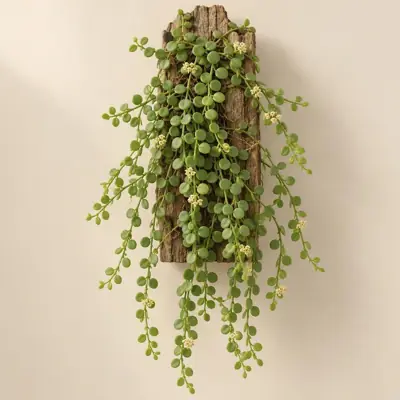
Slender trailing stems bear densely arranged, opposite, small round leaves that resemble strings of coins when hanging, and adventitious roots can form at the nodes. Compared with the similar native Taiwanese Dischidia formosana, Dischidia nummularia has more bluntly pointed leaf tips, whereas Dischidia formosana has indented leaf tips.
Photos