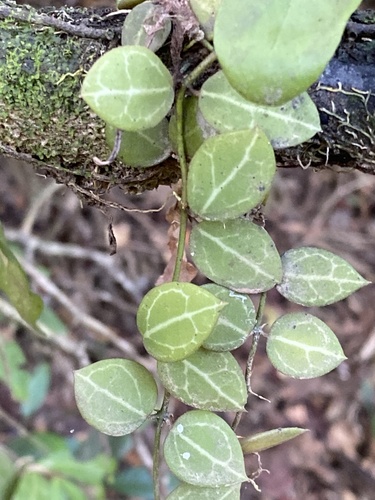
Watermelon dischidia (Dischidia ovata)
Dischidia ovata is a small trailing plant that can climb, creep, hang, or attach to surfaces, and it may grow as an epiphyte or on rocks. It is reported to be a perennial herbaceous plant.
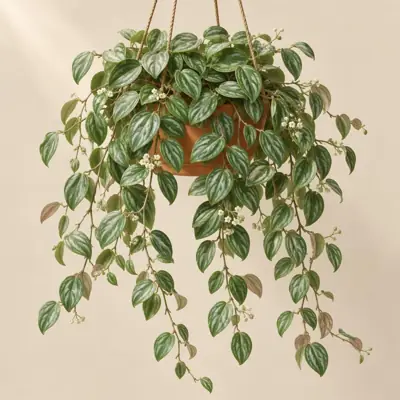
Overview
Dischidia ovata is a small trailing plant that can climb, creep, hang, or attach to surfaces, and it may grow as an epiphyte or on rocks. It is reported to be a perennial herbaceous plant.
Origin and habitat
Its native range extends from New Guinea to northern Queensland, Australia, including the Cape York Peninsula. It grows as an epiphyte or on rocks in various habitats, and sources also describe it as native to humid tropical regions. It is reported to favor humid tropical conditions with shade, high humidity, and good airflow.
Characteristics
A single source reports a mature height of about 5.08–7.62 cm and a mature spread of about 60.96–91.44 cm, so sources are few for these measurements. It is reported to grow quickly. The simple, ovate, entire, hairless leaves are thick, somewhat succulent, and waxy, with silvery-white to white stripes or vein-like markings on the green surface that resemble watermelon rind; bright light may bring out pink to red tones. The flowers are small and inconspicuous, but sources differ on their color: one describes white to creamy-white flowers, while another describes brown to golden-orange flowers that are mostly nearly closed and can form tight clusters along the stems.
Light
Provide bright indirect light to partial shade or shade, and avoid strong direct sunlight because it can scorch the leaves.
Watering
Water moderately after the surface of the growing medium dries, keeping the root medium airy, moist, and well drained; the plant is sensitive to overwatering, while epiphytic plants can receive light, more frequent misting or soaking.
Humidity and airflow
A single source reports humidity of about 60–80 %, so sources are few for this range. It is generally reported to prefer high humidity and need good airflow.
Temperature and dormancy
Sources differ on the lower temperature limit, with a value of about -1.1 °C reported. Sources also differ on its USDA hardiness zone classification. A single source reports an upper temperature of about 29.4 °C, so sources are few for this value. It is generally reported to be frost tender; keep above freezing.
Growing medium and mounting
Use a moist but well-drained, loose, porous medium that keeps the roots aerated; suitable components include perlite, vermiculite, coconut husk, or sphagnum moss, while orchid medium or a light potting mix with more bark can also be used. One source also lists loamy or sandy soil textures and describes a pH span from acidic through neutral to alkaline.
Propagation
Stem cuttings are reported to be the easiest propagation method.
Common problems
Mealybugs, spider mites, and scale insects are reported pests to watch for. Overwatering or poor drainage may cause root rot, while humid conditions or wetting the leaves during watering may lead to leaf spots. Insufficient light may cause elongated growth, and sudden changes in temperature, humidity, or watering patterns may cause leaf drop; overwatering is also reported as a significant cultivation risk. It is sensitive to frost and freezing, and strong direct sunlight, direct drafts, and sudden temperature changes should also be avoided.
Identification
Its thick, ovate green leaves have conspicuous silvery-white stripes or vein-like markings resembling watermelon rind, which gives rise to the English common name Watermelon dischidia.
Photos