
grendelion (Dorstenia foetida)
Dorstenia foetida is a stem-succulent subshrub with a swollen, conical caudex, and its stem may be branched or unbranched. Sources differ on its life cycle and foliage persistence: it is usually perennial, but under tropical conditions it may also behave as an annual or biennial, with leaves either evergreen or seasonally shed.
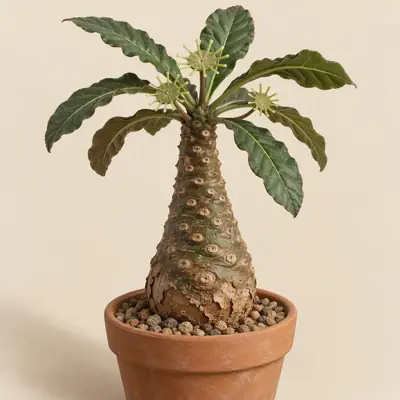
Overview
Dorstenia foetida is a stem-succulent subshrub with a swollen, conical caudex, and its stem may be branched or unbranched. Sources differ on its life cycle and foliage persistence: it is usually perennial, but under tropical conditions it may also behave as an annual or biennial, with leaves either evergreen or seasonally shed.
Origin and habitat
Dorstenia foetida is native to East Africa and the Arabian Peninsula, including Ethiopia, Somalia, Kenya, Tanzania, Saudi Arabia, Yemen, and Oman. It occurs in deciduous and succulent scrub, open ground, and rocky outcrops. Its native environments include dry scrub and rocky habitats, while cultivated plants prefer warm conditions.
Characteristics
Sources differ on mature height, placing it at about 30–40 cm. The alternate leaves are usually concentrated near the ends of stems and branches and vary widely in shape, margin, and shades from light or gray-green to dark green. The small true flowers are densely borne on a flat, shield-shaped hypanthodium that may be gray-green, green, orange, or pink, with linear, horn-like, or tentacle-like marginal appendages; both male and female flowers may occur on the receptacle. Flowering is reported in spring, and the mature fruit or seed structure bursts to eject seeds away from the parent plant.
Light
Sources differ in their light recommendations, ranging from bright conditions to partial or full shade, but cultivation guidance generally favors avoiding strong direct sun and using partial shade or bright filtered light. A light level of 5000–20000 is given for cultivation.
Watering
During the growing period, water thoroughly while allowing the medium to dry slightly between waterings; avoid prolonged wetness and also avoid letting the plant dry out completely, then greatly reduce watering during its more dormant winter state. A specialist source generally recommends keeping it slightly dry while in leaf and watering sparingly while leafless.
Humidity and airflow
A specialist source reports that Dorstenia foetida prefers high humidity.
Temperature and dormancy
Sources differ on the lower temperature limit, with limited reporting placing it at about 0 °C. It is reported to be frost tender and should be kept above freezing. It drops its leaves and goes dormant, and a specialist source reports that dormancy is triggered by cold.
Growing medium and mounting
Dorstenia foetida needs a fast-draining growing medium that avoids prolonged waterlogging or excessive wetness.
Feeding
A specialist source reports using a balanced fertilizer at reduced label strength during the growing period.
Propagation
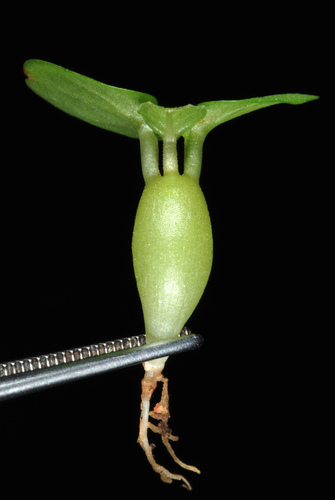
A specialist source reports that Dorstenia foetida is usually propagated from seed, which germinates readily under the stated conditions, and that propagation by cuttings is also possible. Cuttings are also reported as a propagation method.
Common problems
A specialist source reports that prolonged excessive moisture in the growing medium does not suit its cultivation requirements and that some leaf loss occurs during its partially dormant winter state. It is sensitive to frost and should be protected from freezing conditions and kept warm.
Identification
Dorstenia foetida has a thick, succulent, conical stem swollen at the base, with bark that often peels on older stems; spirally arranged scars from fallen petioles, stipules, and inflorescences are visible on the stem, and the shield-shaped inflorescences bear horn-like or tentacle-like appendages.
Photos


Sources
- Wikipedia (en): Dorstenia foetida — CC BY-SA 4.0 · link
- LLIFLE Encyclopedia of living forms: Dorstenia foetida — CC BY-SA · link
- Desert-Tropicals: Dorstenia foetida — © Philippe Faucon (desert-tropicals.com), facts only · link
- The Succulent Plant Page: Dorstenia (genus-level) — © R.J. Hodgkiss, facts only · link
- Top Tropicals catalog: Dorstenia foetida — © Top Tropicals LLC (facts only) · link
- PUKUBOOK: Dorstenia foetida — CC BY-NC (facts only) · link
- Dorstenia foetida | Giromagi cactus and succulents for sale | Buy plants online (www.giromagi.com) — facts only (§12) · link